










The greatest joy of Showtime’s Super Six tournament has been one of discovery – a joy that makes anything worth playing audience to. It is a different joy from what the unexpected brings. The unexpected, husband of anticipation and father of suspense, is born of wrong assumptions disproved, while discovery comes from the unknowing state that wisdom promotes.
If not-knowing how its fights would turn out has been the great joy of the Super Six, Englishman Carl Froch’s fights have been the least-knowable of all, and therefore the most joyful to watch.
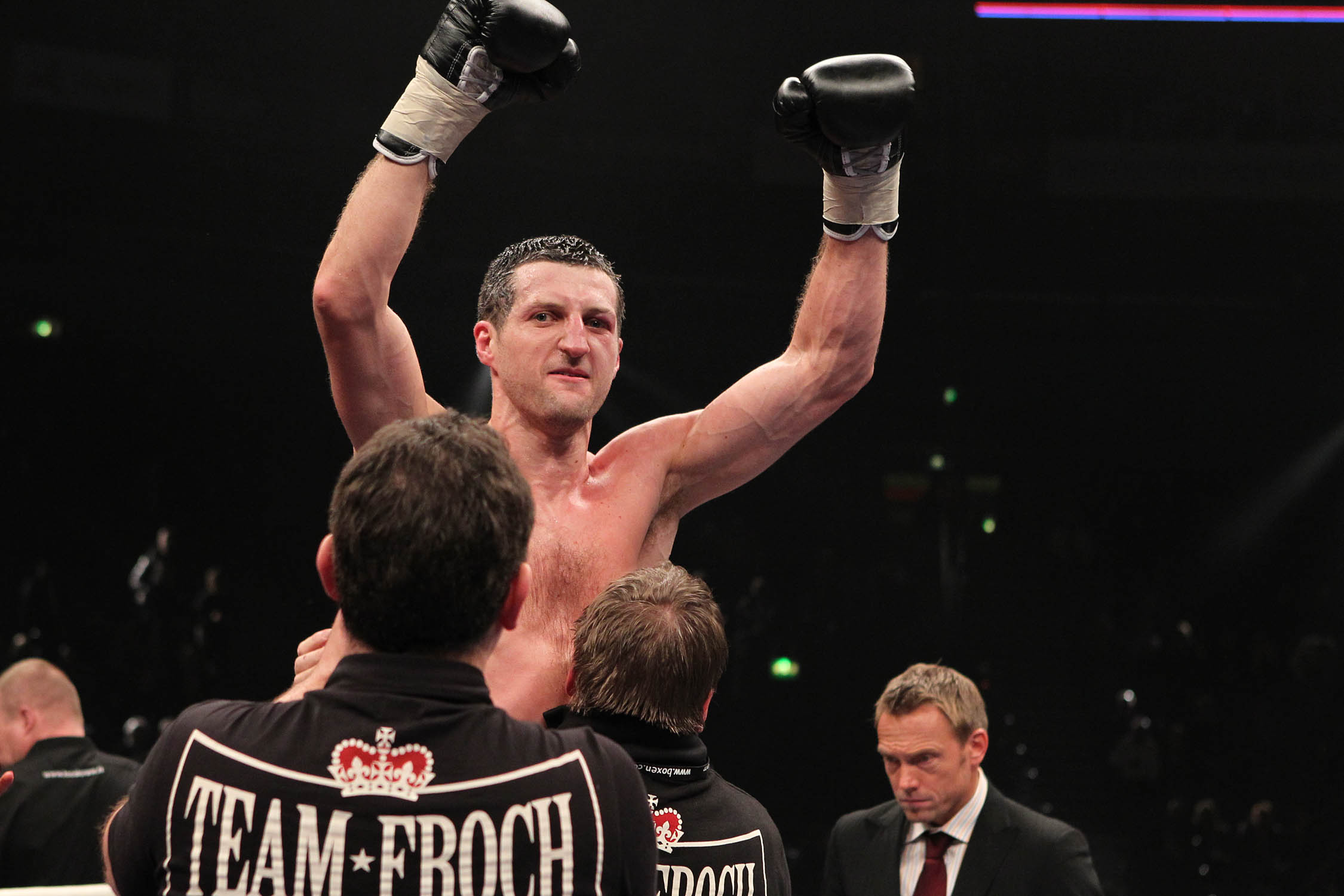
That joy happened again on Saturday when Froch decisioned the ageless Jamaican-born super middleweight Glen Johnson, to retain his WBC title and win a match with Andre Ward in the finals of the Super Six. Fighting before a nonpartisan crowd in Atlantic City, Froch beat Johnson by majority-decision scores of 114-114, 116-112 and 117-111. The match was a fine one, if not quite the fight-of-the-year candidate hoped for by some.
My scorecard concurred with the judges’ ultimate decision, favoring Froch 118-112. I had rounds 3, 4, 5, 6, 9, 10, 11 and 12 for the champion. Rounds 1 and 7 went to Johnson. And I scored rounds 2 and 8 even. Had those even rounds gone to Johnson, my card still would have gone to Froch, 116-112.
It is sometimes important to separate a prizefighter’s score from his performance. Often the two are similar, but there are occasions when a fighter transcends himself without winning rounds. Saturday’s match was not one of these, but it is an interesting possibility just the same.
Though he fought gamely, and at age 42 perhaps surprisingly, Johnson made a performance that left more to be desired of its performer than Froch’s did. Johnson’s supporters, and they are legion, expect their man to expose an opponent’s fragility – both physical and mental. Johnson is a lie detector, in other words.
You may squeak out a controversial decision against Johnson, of course, but your character, whatever it is, will be denuded by Johnson’s assault. You can ask Allan Green about that.
Froch’s character, a charming combination of arrogance and chin and what his countrymen call “bottom,” passed Johnson’s test with high marks. Froch’s performance outranked Johnson’s because, of the surprises that each man brought, Froch’s were the pleasanter.
When he is on, Johnson is relentless. He cannot be dissuaded. He wishes you to engage him. He signs the volume-puncher’s oath: You will hit me, I will hit you, and we’ll see what happens. He does not relent under a rain of clean punches. He cares not a whit for his own appearance. He will wither, he figures, and so will you. It is not a style that is pretty. Johnson does not rely on reflex, or at least he does not fight with a style that does. He steps as he throws the jab. He goes at you low, weight forward, as the best volume punchers must. He wings a left hand at your body to distract you. He hurls a right hand over the top of your lowered guard. The punch hurts you because it surprises you. It surprises you because you cannot imagine such a pedestrian entrance bringing something unanticipated.
“Very strong and durable” is how Froch described Johnson after their Saturday fight. “Sort of like sparring an oak tree.”
Solid as he was against Froch, solid as he always is, Johnson is not without vulnerabilities. One, obviously, is age. The crass vigor of Froch’s youth, akin to a willingness to wager against Johnson’s conditioning – previously a lunatic’s bet – made much of the difference. Johnson would crack Froch, stunning his balance. And Froch would fix an insulted tension to his face and whack Johnson back directly, he would.
The other vulnerability of Johnson’s belongs to every volume punch: the uppercut. To apply constant pressure a fighter must wade forward and often rely on his opponent’s force to stabilize him. The best volume punchers, those of the most inevitable assaults, invariably find their weight too far forward. So long as an opponent throws jabs and crosses and hooks, though, they are safe; only the tops of their heads are exposed. But the first uppercut that grazes their chests or whistles past their ear gives even the most fearless of them pause.
Froch’s right-uppercut lead made a large difference, it did.
And if Froch was surprised by Johnson’s resilience, surely Johnson was startled when his right hands did not affect Froch hardly at all. Some of that was Froch’s conditioning. Some of it was Froch’s chin. And much of it was that Froch’s chin is the one part of his body not even Glen Johnson could find with gloved fists.
Froch does not merely lower his chin in a classic boxer’s pose. Froch sets his chin a full face behind his forehead. Even if Froch did not deflect 50 percent of every right hand with his left shoulder, it would be hard to hurt him.
Froch might not look like Americans expect a fighter to look. He might not have Joe Calzaghe’s genius of motion, either. But he has a fire-tested economy of attack that makes him special.
Still, he has no chance against Andre Ward! So we say about the upcoming finals match. So we believe. Let he who rightly picked a Super Six final of Froch versus Ward, 19 months ago, make the first certain bet against Froch, though.
Hmm, what’s that? No takers?
Well, Froch-Ward is what we’re going to have, a fitting reward for boxing fans who stuck with this tournament through its obstacle course. And the greatest thing that can be said of it is this: The final match will be joyful because its outcome is unknowable.
Bart Barry can be reached via Twitter @bartbarry