




By Norm Frauenheim
The witnesses outnumbered the Senators
Only three of the 28 members of the Senate’s Commerce, Science and Transportation Committee showed up for a hearing that some say could lead to a bill that changes boxing. But the 25 empty seats seemed to say something else. Maybe, the absent Senators were busy kissing Donald Trump’s ring or campaigning for his impeachment.
Ted Cruz was there instead of Cancun. Then again, the Texas Republican had to be. He’s the committee Chairman. Who else was going to ring that silly, cringe-worthy bell? It echoed throughout the room. But the commanding stage was mostly empty. So was the hearing, perhaps because we’ve already heard it all.
The hearing loomed as another step toward what many believe will be the passage of the Muhammad Ali American Boxing Revival Act. It’s being sold as a rewritten version of the Ali Boxing Reform Act, first passed in 1996.
Throughout the last three-plus decades, however, boxing has proven, ad nauseam, that it can’t be revived or reformed.
Or regulated.
It’s not clear how many of the committee’s absent Senators know much about boxing, or how it has governed itself.
Their committee also oversees the Coast Guard. I’m not sure even it could save boxing from itself.
The guess in this corner: Some of the Senators, like a lot of fans, don’t care anymore. It’s on the fringe, pushed there by its inherent chaos, which is often charming yet also a flaw as permanent as a nasty scar.
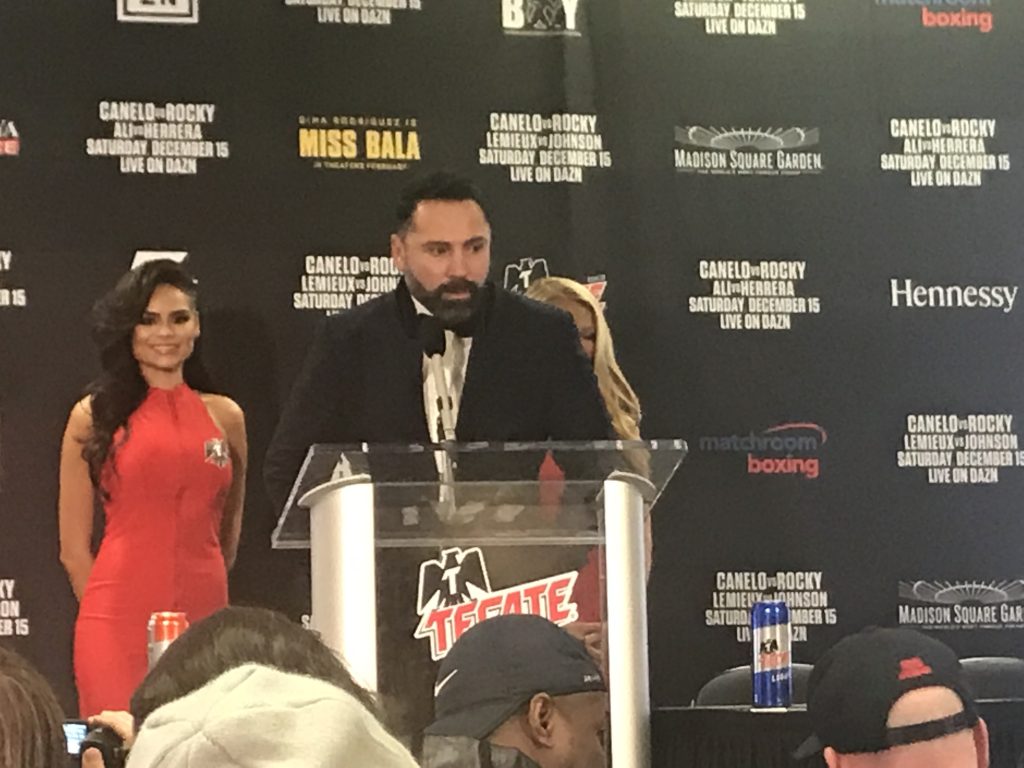
The testimony Wednesday in Washington DC from opponents Oscar De La Hoya and Ali grandson Nico Ali Walsh and supporter Nick Khan, a TKO Group/Zuffa Boxing executive, was competent enough.
De La Hoya, Olympic gold medalist and popular multi-divisional champion, voiced his position in boiler-plate fashion. He was there, he said, to support the first Ali Act. He said it was working the way it was designed, meaning the fighters get a lion’s share of the revenue.
De La Hoya, a Hall-of-Fame fighter was speaking in behalf of the current generation, supporting
boxers instead the billionaires.
As De La Hoya spoke, however, it was hard to forget his role in giving Saudi Prince and promoter Turki Alalshikh an honorary induction into the Nevada Boxing Hall of Fame (NBHOF) before Alashikh’s American debut in Terence Crawford’s 154-pound victory over Israil Madrimov in Los Angeles in 2024. It was embarrassing.
Kahn, a lawyer, was thorough in giving his reasons why the rewritten Ali Act would help bring back money and major networks. Khan blamed the acronyms for the ridiculous accumulation of titles. He’s right, of course. But there are no Four Kings – Sugar Ray Leonard, Marvin Hagler, Thomas Hearns and Roberto Duran – in today’s generation of fighters. Without them, HBO eventually – inevitably – moved on.
From the TKO/Zuffa group, there is also the introduction of another acronym, UBC, Unified Boxing Organizations. Move over WBC, WBA, IBF and WBO, make room for UBC. Acronyms in, acronyms out.
TKO/Zuffa promises enhanced medical care and better money per round for apprentice fighters. But, Ali Walsh argues, that’s just window dressing on a bid to monopolize the sport with long term contracts and rules that would limit what they have been able to earn under the original Ali Act.
Increasingly, the rewritten Ali Act includes devils in the details that look a lot like the UFC model, which resulted in a $375 million settlement in a UFC move to resolve two antitrust lawsuits filed by about 1,200 fighters.
Examples include what Zuffa fighters wear and collect in endorsements. Zuffa fighters wear a Zuffa uniform. Manny Pacquiao once got $2.25 million for wearing an ad on his trunks. Zuffa would have taken a sizable percentage of that, according to reports of what the UBC is planning. It’s a fee, not unlike the controversial sanctioning fees charged by the current acronyms.
Does anybody really think that Shakur Stevenson, recently stripped of a WBC belt for not paying a sanctioning fee, would salute and pay one to a UBC for an ad on his trunks? Didn’t think so. The rewritten bill calls itself American, but nothing could be more un-American.
From Walsh’s perspective, it’s just one detail, a single stitch in TKO/Zuffa’s plan to conquer and monopolize a balkanized sport populated by young fighters, who have worked like individual entrepreneurs. At opening bell, only they are at risk.
UBC control, Ali Walsh said, “removes independence. When that happens, you fight who you’re told to fight, or you don’t fight at all. At that point, real choice disappears…”
Few were ever as independent in word and deed than a grandfather who sacrificed a prime part of his career by saying what he thought in opposition to the Vietnam War.
If the rewritten Ali Act passes, his grandson wants boxing’s most revered name removed from it.
Don’t take Ali’s name in vain.
Carbajal Classic
Michael Carbajal is known for a lot of classics. This weekend he’ll sponsor one.
Carbajal, a Phoenix Hall of Famer and an all-time great in the lightest weight classes, will stage an amateur tournament this weekend at Shrine Auditorium located at 552 North 40th Street in Phoenix.
The Michael Carbajal Classic, a USA Boxing sanctioned tournament, begins with preliminaries Friday at 5 p.m. It will continue Saturday and Sunday.