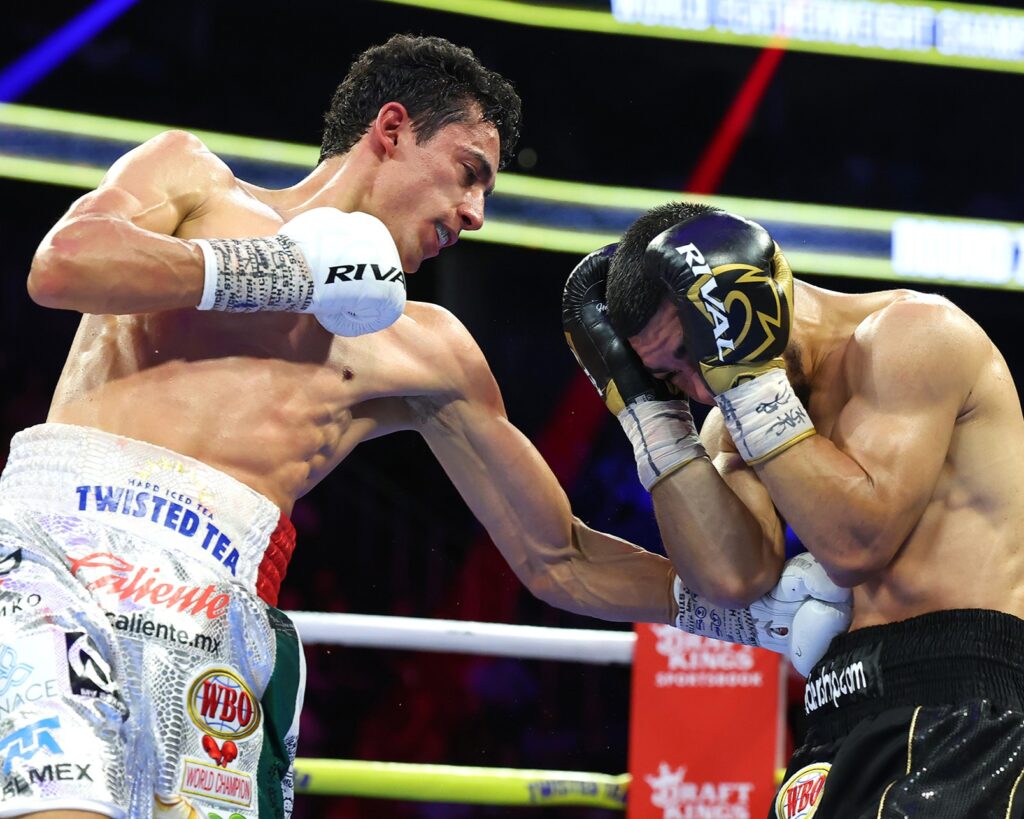
Boxing regulation, like colossal shrimp, is often a classic oxymoron, two words aligned yet always in conflict. After all, boxing is at its roguish best or perhaps worst when it avoids regulation. It’s been a way of doing business
These days, however, two emerging faces from the promotional side – one with unprecedented money and the other with White House connections – joined the regulatory side in an apparent effort to gain control over the balkanized game.
It’s hard to understand why else Prince Turki Alalshikh, the money man from the Saudi monarchy, and Dana White, UFC kingpin and friend of Donald Trump, played politics a week ago in seeking an endorsement from the
California State Athletic Commission.
Alalshikh and White, fresh off their triumph in the promotion of Terence Crawford’s masterful decision over Canelo Alvarez last month, are trying to push through the proposed Muhammad Ali Boxing Revival Act.
It’s supposed to replace the shopworn, often forgotten Ali Act, the original attempt to bring some ethics and order to a business known for notorious practices. For too long, fighters have been protected only by a sturdy mouthpiece.
Late Senators John McCain of Arizona and Harry Reid of Nevada had good intentions when they crafted the bill, introducing it in 1999 and enacting it in 2000. Both were former boxers. They understood the sport and the fighters. Both also got a lot of help and advice from Hall of Fame trainer and ringside commentator Emanuel Steward.
But all three are gone. Guess here, all three would see through what White and Alalshikh were doing at the California Commission. It was a campaign stop – a dog-and-pony show — for legislation that could strengthen their control of boxing when their Zuffa promotional banner debuts next year.
It’s evident that Alalshikh and White are trying to eliminate rivals and perhaps critics. White, an unchallenged giant in his promotion of mixed martial arts, says he wants to go into boxing without the old acronyms or rival promoters.
Part of the reported plan is to recognize only The Ring’s title.
It’s no coincidence that Alalshikh bought The Ring from Oscar De La Hoya last November for a reported $10 million. Then, De La Hoya, who has been feuding with White for years, thought he was selling a magazine, a century-old trademark. But now he knows he sold off a piece of what they intend to use as a further way dominate the business.
From this corner, however, it’s not clear that their proposed changes to 25-year-old legislation will have any more of a lasting impact than the original has had. The criticism of the McCain-Reid bill – bi-partisan and well-intended – is that it didn’t include any real way to enforce laws written to protect the fighters themselves.
An example: The Ali Act was supposed to eliminate the confusion about the difference between promoter and manager. But it’s still there, a conflict-of-interest that often leads to a double dip, leaving the unsuspecting fighter with only enough money for that new mouthpiece.
McCain, a Republican, and Reid, a Democrat, got a lot of endorsements for their legislation from fighters, media and fans when it was introduced.
But there’s no enforcement in another endorsement, which — for now — is the only thing fighters got from White and Alalshikh.
Coming back? Fury always is
By Norm Frauenheim
Just when it looked as if boxing was facing only questions about shifting politics amid uncertainty over whether familiar faces are moving on as new ones move in, along comes Tyson Fury with an announcement that says one thing isn’t changing.
Fury, or at least his promoter, says he’s coming back.
Isn’t he always?
Fury’s comeback, unabridged and uninterrupted, will continue sometime next year, his promoter Frank Warren told Sky Sports last Wednesday.
It’s long been thought that Fury’s comeback would inevitably lead to Anthony Joshua. Apparently, however, Fury has other ideas, according to Warren, who says he is pursuing the third leg in a trilogy with Oleksandr Usyk.
“The fight he really wants is another bout with Mr. Usyk,’’ Warren said. “Those were wonderful, very close fights that were a pleasure to watch. He keeps talking about it.’’
Trouble is, Usyk isn’t talking about it. Neither are fans. Usyk’s disciplined mastery of tactical skill won the first two fights, both in 2024.
The scorecards from each are a sure indication that Usyk has figured out Fury. In May, Usyk wins by split decision. In a December rematch, the Ukrainian is the unanimous winner, 116-112 on all cards. Everybody knows where this one is headed. Been there. Done that. Why do it again?
Fury probably knows that. He also knows the promotional art better than even Warren. His comeback talk about Usyk is perhaps just an opening salvo in firing up fans for the one UK bout still on their most-wanted list. Fury-Joshua still makes money, although only Saudi Prince and promoter Turki Al-Sheikh can afford to pay the purses for a fight that would belong in London instead of Riyadh.
If it can’t be put together, it’s time for the 38-year-old Fury to get off his career-long comeback trail and make room in the media landscape and public imagination for Moses Itauma.
Itauma, a powerful 20-year-old UK heavyweight, is poised to join light-heavyweight David Benavidez, super-flyweight Jessie “Bam” Rodriguez and newly-minted junior-middleweight Jaron “Boots” Ennis in a looming race to become the face of a game suddenly without one.
From retirement to rematch, it’s not clear what’s next for Terence Crawford and Canelo Alvarez.
Crawford is 38. Within a couple of weeks after losing to Crawford in front of a reported Netflix audience of more than 42 million, Canelo, 35, announced plans to undergo elbow surgery.
Maybe Crawford and Canelo fight a couple of more times. Maybe, not. Maybe, they fight each other once again. Maybe not. Whatever they do, they’re a lot closer to an exit than Fury Road, a comeback seemingly never near an end
Beyond Canelo: David Benavidez going up scale for good
By Norm Frauenheim
David Benavidez, who is moving up the scale in weight and prominence, didn’t surprise anybody this week when he said he would never fight at super-middleweight again.
He doesn’t have any choice.
Gaining weight and smarts are part of growing up, and the maturing Benavidez is showing a lot of both as he enters his prime at light-heavyweight, a steppingstone toward his hopes of making an enduring statement as perhaps the best of his generation.
Put it this way: At 6-foot-2, Benavidez, who will be 29 on Dec. 17, has a better chance at fighting one day at heavyweight than he has at ever going back to 168 pounds.
The biggest surprise is that he was able to stay at super-middle for as long as he did. He missed weight once, costing him the World Boxing Council’s version of the title in 2020. Over the next three-and-half years, he went on to win six straight bouts as the super-middleweight division’s most feared contender
Truth is, Benavidez is at a weight he probably should have been a few years ago. He actually fought at 175 pounds more than a decade ago – April 2015. As an unknown 18-year-old, he won a fringe NABF title with a first-round stoppage at Celebrity Theatre in hometown Phoenix. Then, he stayed – perhaps overstayed – at 168. A futile wait for a shot at Canelo Alvarez kept him there.
Now, he moves on, beyond a familiar weight and an exasperating wait in his third bout at light-heavy in a title defense against a dangerous gatekeeper, Anthony Yarde, a UK fighter who figures to test Benavidez’ future in his step up the scale Nov. 22 in Riyadh.
Benavidez announced the inevitable in an interview with Fight Hub TV in answer to a question first posed by Saudi Prince and promoter Turki Al-Sheikh at the end of Terence Crawford’s masterful decision over Canelo last month at Las Vegas’ Allegiant Stadium.
“Can David Benavidez still make 168?” Al-Sheikh asked in a tweet.
Definitely not, Benavidez told Fight Hub.
“I’m done,’’ Benavidez told Fight Hub in his formal farewell to super-middle. “I want to take this opportunity to congratulate Crawford. He put on a hell of a performance. He’s up there on the Mount Rushmore of the greatest fighters of all time. Let Crawford do his thing, bro. At the end of the day, I have no interest in fighting Crawford.
“I have no interest in going down to 168. Yeah, it would be dope, winning all the titles, but I’m way past that at 168. I wouldn’t even go down to 168 for Canelo. I’m just being real with you.”
With his decision over Canelo for the unified title at 168, Crawford did Benavidez a real favor. For too long, Benavidez’ career — and identity — had been defined by his chase for a rich date against Canelo. For now, that’s gone, forced by Crawford’s victory and Benavidez’ natural progression up the scale.
But it’s more than just a step away from Canelo. For Benavidez, it also represents a significant early step into his prime. For him, it’s an opportunity to make — and remake — his identity as a potential pound-for-pound contender.
There’s still a chance, of course, that Canelo comes back from elbow surgery and decides he’s finally willing to fight Benavidez, especially if Benavidez beats Yarde and goes on to a unified light heavyweight title against Dmitry Bivol and/or Artur Beterbiev.
There are lots of questions about what’s next for Canelo, yet there’s a consensus that a fight against Benavidez would still make money. Fans have clamored for Canelo-Benavidez for years. They’re not going away.
If that possibility is resurrected, however, it could be on different terms, this time forged by Benavidez, bigger both in body and name.
Canelo set for elbow surgery that also might repair his chances at Crawford rematch
By Norm Frauenheim
Unintended consequences, or at least attention and speculation, have been there for Terence Crawford and Canelo Alvarez in the wake of their fight, one of the biggest in years.
That’s no surprise. More than a reported 42 million watched on Netflix. More than 70,000 watched in person. Everybody walked away wondering what’s next.
From the fighters, however, there’s been mostly silence, especially from Crawford, the winner whose hometown celebration took a wild turn when he was held at gunpoint in a traffic stop just hours after Omaha gave its loyal son a key to the city.
Crawford has yet to comment about what happened early Sunday. If he’s going to say anything, the best guess is that he’ll wait until a possible court appearance, perhaps in December. A crush of speculation and an ongoing in-house investigation by Omaha police suggest that’s the only smart move. Crawford has made a lot of those over the last couple of years.
Meanwhile, Canelo also has been silent about news, reported by The Ring, that he’ll undergo surgery on his left elbow.
At 35 years old, that raises questions, lots of them He’s talked about retiring when he turns 37. But he’s under contract for two more fights with Saudi Prince and promoter Turki Alalshikh, whose seemingly unlimited bankroll is revolutionizing the prize-fighting biz.
The guessing game has Canelo, who will be 36 next July, returning to the ring some time in mid 2026. His next opening bell had been expected in February. Now, it looks as if he won’t fight again until sometime between May and September – Cinco de Mayo and Mexico’s Independence Day on Sept. 16
The biggest question, of course, is against whom? His army of Mexican fans want to see him avenge his scorecard loss to Crawford. But Crawford’s dominance raises questions whether a sequel would be any different.
In hindsight, the cards – 115-113 twice and 116-112, all for Crawford, look to be too close, especially the 115-113 scores.
Canelo never had a chance.
Why would he have one eight to 12 months from now?
Good question, but news of the surgery already is generating some second-guessing about whether Canelo’s left elbow was somehow injured before opening bell.
He never complained about it during or after the fight, yet his partisans already are pointing out that, according to ringside stats, he landed only 16 jabs in losing the undisputed super-middleweight title Sept.13 at Las Vegas’ Allegiant Stadium.
But he’s never been known for his jab. The power in his left hand is considered his best weapon. Would he have had a better chance if it had been attached to a healthy elbow? The answer might be as much marketing as it medical.
The questions are all part of speculation that often leads to a hunger for more.
For both, there are rich reasons to do it all over again. Count them. Bank them. There are more than 150-million reasons. Canelo collected an astonishing $100-million-plus, according to Alalshikh.
Yet, Canelo, who is getting ready for surgery on Oct. 23, isn’t talking about the reported injury.
He doesn’t have to. Everybody around him is talking about it and how surgery might repair an elbow and the public interest in a rich rematch.
Omaha gives Crawford a key to the city, then holds him at gunpoint
By Norm Frauenheim
Terence Crawford’s celebration of a career-long fight for respect took a crazy turn when Omaha honored him with a parade Saturday and held him at gunpoint early Sunday.
Crawford was released and no charges were filed, according to multiple reports which included a statement from Omaha Mayor John Ewing and a promise to investigate from city police Chief Todd Schmaderer.
As of Sunday, Crawford had not commented on what happened early on his birthday and just hours after Omaha gave him a key to the city.
According to social-media reports, Crawford spent his first few hours as a 38-year-old in handcuffs. If accurate, his key to the city wasn’t enough to unlock them.
According to sourced news stories, Crawford’s vehicle was stopped for reckless driving just before 1:30 a.m., Central time. According to reports and posted video, he was the driver. Crawford and three passengers were ordered out of the car at gunpoint after a weapon was seen.
Omaha police issued a statement. Police, it said, stopped a vehicle that was traveling “recklessly.” During the stop, “a firearm on the driver’s side floorboard” was “observed.” For safety, “all four occupants were ordered out of the vehicle at gunpoint.”
According to the statement, police questioned Crawford and found that he had a legal permit to carry the weapon. A member of Crawford’s security team was among the passengers. According to the police report, he also was found to be carrying a weapon.
“Police have confirmed that all occupants are legally permitted to carry firearms,” the statement said.
Omaha police also confirmed that Crawford requested that a department supervisor and lieutenant be called to the scene.
At the time of the stop, somebody in the vehicle can be heard saying on a social-media post that “I’m not reaching for no gun” as the officer orders them to “step out.’’
According to the video, Crawford – remaining as poised outside of the ring as he is in it — calmly cooperated with every order, including keeping his hands raised above his head. He was cited for reckless driving.
The controversial moment happened after an estimated 100,000 turned out for a parade honoring Crawford for a masterful upset of Canelo Alvarez in Las Vegas a couple of weeks ago, Sept. 13. With the victory, he made some history – a third undisputed title at a third weight.
Crawford has long been known for being Omaha’s loyal son. Boxing is populated by prizefighters who leave their roots to live in Vegas or Los Angeles.
But Crawford stayed home, drawing huge crowds in Omaha and nearby Lincoln. Famed billionaire investor Warren Buffett is often seen in a seat alongside Crawford’s many fans for fights in his home state.
Against Canelo, Crawford’s mouthpiece included Nebraska’s red football logo, N, front and center.
Omaha, all of Nebraska, decided to honor Crawford after he honored the city and state with a decision over Canelo that reminds many old-school fans of why boxing was once called The Sweet Science.
Even before the parade, it wasn’t clear what he’ll do next. There might be another bout. Might not. From a farewell fight at the Cornhuskers’ college football stadium in Lincoln to a Canelo rematch or a bid for still another divisional title, the possibilities are a lot like the countless angles on his punches.
Whatever’s next, however, has been complicated, left even more uncertain by questions that just weren’t there on a weekend that began with a celebration stopped in a way neither he nor anybody else could foresee.
Legacy or Encore: What’s next for Terence Crawford?
By Norm Frauenheim
A performance that reminds us why boxing was once called The Sweet Science screams for an encore.
In the days after Terence Crawford pulled a fading craft off the fringe and back onto center stage for 12 magnificent rounds in a masterful decision over Canelo Alvarez, there’s an inevitable clamor for more.
Fans and media are asking: Who’s next? A lot of fighters, some worthy and most not, are asking to be next. But there’s no immediate next on Crawford’s calendar, other than a birthday.
He’ll be 38 on Sept. 28, just 15 days after he celebrated a victory watched by more than a reported 41 million on Netflix and more than 70,000 at Vegas’ Allegiant Stadium last Saturday.
It’s an age – early middle-aged — that comes with questions. At 37, Crawford answered many with sustained movement and footwork not expected by a fighter with more than 40 bouts on his odometer.
Crawford never stopped in a tireless dance that confused Canelo, who saw Crawford in a different spot, with a different posture and at a different angle at almost every turn.
In the end, there was more than just confusion. It left Canelo, the younger man, without options and energy. He was exhausted. Crawford, the 35-year-old Canelo said, did everything.
Everything, other than knock him out.
Maybe it’s just coincidence, but Crawford patiently applied every element in his endlessly versatile skillset throughout. For one night, he managed to do all of what he does best. For most of his career, he was a finisher. We knew that, it’s there in his unbeaten record – 31 KOs in 42 wins.
Against Canelo, he had a chance to display even more.
In the days since the scorecards – 116-112, 115-113 (twice) were announced, the video of his comprehensive victory has been studied and re-studied for segments that were just missed.
Here’s classic: A double left hand.
First, it lands squarely between Canelo’s eyes. Canelo seems to look away. As he does, that same left hand drops down by an inch, maybe two, and then lands onto Canelo’s jaw, all delivered as Crawford ducks in and away.
It was a thing of beauty, art according to the book on The Sweet Science.
Canelo’s reaction says it all. Stunned, he looks back at Crawford in disbelief, as if to say: Where in this universe did that punch come from?
It was a moment – one of many, that secured Crawford’s place as the best in his generation. Today, he’s the consensus – if not unanimous — pound-for-pound champion, ahead of heavyweight Oleksandr Usyk and junior-featherweight Naoya Inoue, who delivered his own statement with a dominant decision over Murodjon Akhmadaliev in Japan just a few hours after Crawford’s triumph.
For Crawford, the history-making victory for a third undisputed title at three weights in his first bout at super-middle was a definitive counter to the critics who have questioned his record for years. Repeatedly, his credibility was undercut by doubt about the quality of his opposition.
Those doubts, perhaps, were reflected by the 115-113 scores. The 116-112 score was more accurate. On this scorecard, the margin grew – 116-112 in the arena to 117-111 the next day after watching the video.
Against Canelo, Crawford simply proved – round after round — he’s just been better than everybody else.
The dominance suggests that there’s more than that. Crawford has plenty of fight still within him.
But it also includes a question about what another fight or two might do to his legacy as an all-time great. There’s a pretty good argument that he has run out of opponents.
A rematch was mentioned. A second fight against Canelo would probably make money. But it’s hard to imagine a different result against the faded Canelo (63-3-2, 39 KOs), who has been fighting professionally since he was 15 years old and still had freckles. The popular Mexican is 68-fights old, and it’s beginning to show.
The other possibilities swirling around Crawford’s future are predictable.
There’s the emerging Jaron Ennis, Canelo’s sparring partner for Crawford.
There’s talk about a move down to middleweight – from 168 pounds to 160 – for another division title – his sixth.
There’s even David Benavidez, a former super-middleweight champion from Phoenix now training for a light-heavyweight title defense against Anthony Yarde in Nov. 22 in Riyadh.
Saudi Prince and promoter Turki Alalshikh teased the Benavidez possibility from his ringside seat late in Canelo-Crawford by asking on social media whether the 6-foot-2 Benavidez could still make 168.
Maybe, but at 28 and counting, Benavidez will only mature, which means more pounds and an even heavier division. In another year or two, he could be at cruiserweight, 200-pounds.
Crawford’s victory on one of boxing’s biggest stages in years includes prerogatives. To wit: He can do whatever he wants. But at what cost?
In a notable quote at the post-fight news conference in a tent outside of Allegiant, Canelo was asked to compare Crawford with Floyd Mayweather Jr., who beat him twelve years ago by decision in September, 2013.
“Crawford is way better,’’ Canelo said.
That one comment is a bigger victory for Crawford’s legacy than another title, say the middleweight belt held by 42-year-old Erislandy Lara.
It’s also a legacy, including an unbeaten record, maybe worth protecting against one of those young lions — Ennis, unbeaten at welterweight and seeking to move to junior-middle and/or a much bigger Benavidez.
Legacy or encore? This time, it’s a decision only Terence Crawford can make.
Crawford makes history, takes down Canelo for third undisputed title
By Norm Frauenheim
LAS VEGAS – There was no blood. There were no knockdowns. There was only Terence Crawford.
Crawford’s dance, as brilliant as it was defiant, continued Saturday, reaching a peak few others have achieved or even imagined with an upset of Canelo Alvarez in front of a crowd of 70,482 at Allegiant Stadium.
Crawford, booed when he entered the arena and booed for weeks after the fight was announced, did what he was always done in his historic path to undisputed title in three weight classes.
He did it with his feet, frustrating Canelo at almost every turn in winning a unanimous decision. It was 115-113 on two scorecards and 116-112 on the third. Two of the cards appeared to be closer than what the dominant Crawford did in moving across the ring, in and out of harm’s way and into history.
Canelo always seemed to be a step behind, a dance partner that couldn’t quite keep up with the master.
If there was a surprise, it was in Crawford’s footwork. He moved his feet with an agility not seen in almost a decade. For 12 rounds, the 37-year-old Crawford sustained the dance that earned him the undisputed super-middleweight title and a place among boxing’s all-time greats.
If he had been around in another time, the game would have Five Kings alongside the foursome of Ray Leonard, Marvin Hagler, Thomas Hearns and Roberto Duran.
In his hometown – Omaha, they simply call him Bud. On this night, however, boxing historians could have called him Sugar. He was that good, a former welterweight and junior-welter champion coming up two weight classes to take down Canelo, one of the most feared punchers in his day,
After it was all over, Crawford (42-0, 31 KOs) went to one knee and looked toward Allegiant Stadium’s ceiling as though he was looking to the heavens.
Thanks, he said
The thank-you was preceded by a confident Crawford who opened the fight in the southpaw style. His right hand led the attack and hinted at imminent alterations. But he never switched up, never went from left-handed to right-handed. But the threat was always there, forcing Canelo to be wary.
Above all, Crawford’s two-handed, ambidextrous threat threw some hesitancy, if not outright confusion into Canelo’s tactical plans.
Crawford right hand landed first, followed by a glancing left in the opening round. The crowd roared. Canelo remained cautious.
But in the second round, the popular Mexican hinted, perhaps, at what he had planned. He moved forward, almost stalking and in an almost straight line that led him to his target: Crawford’s midsection.
The body punch landed, forcing Crawford to step to one side and then another. In the third, it began to look as if Crawford was poised to pick up the pace.
In the fourth, he did, landing a couple of quick hands, first a right than a left. Momentum in the fourth, however, suddenly shifted when Canelo landed a straight right hand. Crawford looked at at him and smiled as if to say: You can’t catch me.
Over the next eight rounds, Canelo never could.
Callum Walsh dominates in one-sided decision over Vargas Jr.
Callum Walsh had too much power and too much accuracy.
In the end, he had too much of everything in overwhelming Fernando Vargas, Jr, who has a legendary name but none of his father’s resilient skillset.
On the scorecards, Vargas (17-1, 13 KOs) never had a chance. The judges nearly scored the 10-round junior-middleweight fight as a shutout for Walsh (16-0, 11 KOs), an agile Irishman who knows his way around the ring.
It was 99-91 on two cards and 100-90 on the third in the final fight before the Terence Crawford-Canelo Alvarez main event at Allegiant Stadium.
Mbilli, Martinez fight to a bruising draw
It was punishing, a fight full of momentum swings and exhausting exchanges of punches that landed everywhere and from all angles. It was hard to pick a winner.
In the end, nobody could..
Christian Mbilli-Lester Martinez was a draw. The good news is that the super-middleweight fight set the stage for a sequel and perhaps a great new rivalry. The only winner was the gathering crowd for the main event, Canelo Alvarez-versus-Terence Crawford. The early undercards didn’t offer much in terms of drama. Allegiant Arena eats were empty. Knockouts were few. Cheers were muted.
Then, Mbilli and Martinez stepped through the ropes.
In the early rounds, it looked as if Mbilli (29-0-1, 24 KOs) might win easily. He appeared to have an edge in the number and power of inside punches. In the middle rounds, however, Martinez. (19-01, 16 KOs), showed a stubborn streak and and his own brand of body shots and uppercuts. The Guatemalan wasn’t going anywhere. In the eighth and again ninth, it looked as if the body assault had robbed Mbilli of his energy. He looked fatigued.
In the final moments of the tenth and final round, however, Mbilli recovered, scoring repeatedly and often enough to perhaps ensure a draw. One judge scored it for him, 96-94. One scored it for Martinez, 97-93. On the third, it was a draw, 95-95
Can’t wait for the rematchThe punishing fight ended with exchanges of punches and moment
Mohammed Alakel wins unanimous decision
Saudi junior-lightweight Mohammed Alakel (5-0, 1 KO) employed faster hands and feet, scoring quickly and repeatedly for a unanimous decision overTravis Crawford (7-4) a hard working fighter from (7-4-1) from Corpus Christi, TX in the first fight on the Netflix part of a card featuring Terence Crawford-versus-Canelo Alvarez at Allegiant Stadium Saturday.
Brandon Adams wins rematch, scores decision over Bohachuk
Brandon Adams wore a gray wig to news conferences and weigh-ins. He shed the costume in the ring and answered questions about his age with a variety of punches.
Body shots, hooks and uppercuts were repeated answers to Serhii Bohachuk, who called the 36-year-old Adams — a Los Angeles middleweight — an old fighter.
Age is just a number, or at least it was for 10 rounds of punishing shots from multiple angles from Adams in a rematch victory Saturday at Allegiant Stadium over Bohachuk (26-3, 24 KOs) , a Ukrainian known for his power.
In the end, Adams made the 30-year Bohachuk look old. Adams, who scored an eighth-round TKO of Bohachuk in 2021, landed shots almost at will, winning a unanimous decision in the final fight before the Netflix portion of the Canelo-Crawford card.
Jermaine Franklin wins dull decision
It was unanimous.
On the cards.
And in the seats.
Jermaine Franklin Jr. won the decision. He also shared some of the contempt hurled at Ivan Dychko from a few fans scattered across Allegiant Stadium’s 65,000 seats Saturday on the Canelo Alvarez-Terence Crawford card in a heavyweight matinee Saturday.
Franklin (24-2), of Saginaw MI, and Dychko (15-, 14 KOs), a two-time Olympic bronze medalist from Kazakhstan, clinched and clutched more than they punched through 10 forgettable rounds. By the fifth, the scattered crowd began to jeer. By the eighth, the boos began to echo through the empty arena.
By the end of the 10th, there were cheers.
Finally, it was over.
Tsutsumi scores first-round stoppage
Reito Tsutsumi, a Japanese junior lightweight, didn’t need much time, mostly because Javier Martinez didn’t have much of anything at all.
Tsutsumi (3-0, 2 KOs) did it all within 2:18, walking down Martinez (7-3,4 KOs), hurting the Dallas fighter first with a succession of body shots and then finishing him with with straight punches that put Martinez on the canvas, a lonely figure in an empty building early on a card featuring Terence Crawford-versus-Canelo Alvarez fight.
Sultan Almohammed made a succsessful pro debut with a four-round unanimous decision over Martin Caraballo in a lightweight bout.
In round one, Almohammed dropped Caraballo with a right to the jaw.
Almohammed, 132.5 lbs of Jeddah, SA won by scores of 40-36 on all cardsa and is now 1-0. Caraballo, 133 lbs of Hollywood, FL is 0-1-1….Marc Abrams
Raiko Santana scored a mild upset by stopping Steven Nelson in the opening round of their 10-round light heavyweight bout.
Santana landed a hard right hand that hurt Nelson and a follow-up flurry forced the stoppage at 2:38.
Sanatana Of El Paso, TX is 13-4 with with seven knockouts. Nelson of Omaha, NEB is 20-2…...Marc Abrams
Potential Mexican star, Marco Verde stopped Sona Akale in round our of their six-roumd middleweight bout.
In round one, Verde landed a right hook that put Akale on the canvas.
In round four, Verde continued the assault and referee Mark Nelson stopped the bout at 1:11.
Verde, 158 lbs of Mazaltan, MEX is 3-0 with two knockouts. Akale, 158 lbs of St. Paul, MN is 9-4….Marc Abrams
Canelo-Crawford: Huge crowd turns ceremonial weigh-in into a celebration
By Norm Frauenheim
LAS VEGAS – It was called ceremonial. But a huge, roaring crowd called for it to be known as something else.
Something more.
Much more.
It was off the scale, a Woodstock of weigh-ins Friday at T-Mobile Arena for a crowd that gathered in huge numbers and generated noise that echoed up-and-down the Vegas Strip in a sure sign of mounting interest in the Canelo Alvarez-Terence Crawford fight Saturday night at Allegiant Stadium.
The weigh-in, the real one, had already happened, hours earlier in a chilly, quiet ballroom in a luxury hotel at the opposite end of The Strip.
For the record, both Canelo and Crawford weighed the same, each at 167.5 pounds, safely under the super-middleweight’s 168 limit.
There wasn’t an ounce of difference between them, perhaps an indication of just how close this fight for Canelo’s super-middleweight title really is. The late afternoon weigh-in was staged to sell a few more tickets and Netflix subscriptions.
But the crowd, perhaps as big as any in Vegas’ long and colorful boxing history, delivered an exclamation point to anticipation rare in this era of boxing. It’s been called a dying sport. From lower bowl to the upper deck at T-Mobile, however, that obituary sounded premature Friday.
This ceremony wasn’t a funeral. It was a celebration. Even Crawford and then Canelo seemed almost surprised at the roar that greeted them as they walked onto the stage and stepped onto a scale that was little more than a prop.
It came with expectations, all of which will echo throughout the hours before opening bell in a ring that figures to be near the 50-yard line on the Raiders home field.
Canelo, the favorite, spoke to the crowd of Mexican partisans with a promise to do everything.
“I trained for everything,’’ said Canelo, who continues to be a narrow betting favorite. “I’ll need to do everything in this fight.”
He said it in a way that suggested some emerging respect for Crawford and his comprehensive skillset.
Throughout the build-up for the fight, there’s been a sense that Canelo and Crawford are more than just business partners in a bout that reportedly will add at least $100 million to Canelo’s net worth. They like each other. There’s been no trash talk and an absence of dismissive gestures.
Crawford, a two-time undisputed champion at welterweight and junior welter, hears boos only from the Canelo fans. They – fans and boos — were everywhere Friday.
Crawford jumped on and off the scale quickly Friday. He exited the stage, before Canelo spoke. Then, the promoters asked him back for a word.
When he returned, there they were, the boos all over again.
Nobody had to ask him about them. Instead, he was asked:
How are you feeling?
“Lovely,’’ Crawford said as if he were enjoying a deep breath of the noisy element that has motivated him throughout his brilliant career.
Defiance is Crawford’s oxygen.
“I can’t wait for tomorrow,’’ he said.
This time the crowd only roared, as if to say nobody else can either.
Canelo-Crawford: Lots of talk, but roles stay the same
By Norm Frauenheim
LAS VEGAS – First, there was Terence Crawford, dressed in a white top and a friendly smile.
Then, there was Canelo Alvarez, his eyes hidden by sunglasses darker than the undershirt he was wearing.
For about the next hour, both answered questions, talked philosophy, exchanged a few promises and threats.
There were a lot of roles on stage at T-Mobile Arena throughout a news conference Thursday, and both fighters played them well for a super-middleweight fight hard to predict, yet loaded with story lines and opinions
Sometime after opening bell at nearby Allegiant Stadium Saturday night, however, neither the opinions nor the stories will matter much in a ring near the 50-yard line of the NFL Stadium.
That’s when Canelo and Crawford will take matters into their own hands – hands as dangerous as any over the last decade of prize-fighting
Boxing newsers are always part of the show, of course. They set the stage for feints and perhaps a little bit of psychology. Rhetorical jabs before the real ones.
Crawford and Canelo were there, each with an answer for whatever was asked in front of a crowd that has already made up its mind.
For Crawford, that means changing minds.
For Canelo, it means affirming what many already think in the remaining hours before the Netflix-streamed bout.
No matter what else was said Thursday, Crawford and Canelo were in the place they’ve been since their intriguing super-middleweight fight was announced several weeks ago.
Crawford is the underdog, defiant and yet seemingly happy to be in the role.
“They say I’ve fought nobody, they say I can’t sell, they say I’ve got no personality,’’ Crawford said with the defiant edge that has helped him forge a career with skeptics but no losses
For the last decade, Crawford has proven everybody wrong. It was clear Thursday that he intends to deliver some definitive say-so against Canelo, who has played the popular favorite throughout most of his career.
It was no surprise that Canelo was the crowd favorite at Thursday’s newser. He’s been a powerful favorite for about as long as Crawford has been doubted.
The news-conference crowd amplified its expectations Thursday. It is betting Canelo’s long reign as Mexico’s best fighter since Julio Cesar Chavez will continue.
Canelo said he doesn’t listen to cheers or criticism. Maybe not. Go ahead, he says, and debate about his place in Mexican history, which has for long started and ended with Julio.
“In the end, the people will decide,’’ Canelo said. “The numbers will be there or they won’t.’’
For now, however, the numbers are in the seats, there at least in terms of support for Canelo in his risky date as the bigger man in defense of his undisputed super-middleweight.
Those numbers also add up to what might be an astonishing paycheck. There’s talk that Canelo will collect $100-million for fighting Crawford
Wrong, Saudi Prince and promoter Turki Alalshikh said Thursday.
“Our contract is for more than that,’’ said Alalshikh , who negotiated a three-fight deal in an 11th hour offer that convinced Canelo to agree to the Crawford fight.
Like the purses perhaps, Crawford, it’s thought, will enter the ring smaller. He’s a former undisputed welterweight and junior-welter champion, who is jumping up the scale from junior-middleweight to fight Canelo.
The Canelo chants, like the expectations, were bigger Thursday, echoing throughout the building like an old lyric.
Crawford heard them and smiled. He’s been there. Defiance has been his lifestyle. He’s good at it, and he intends to be just as good for at least one more time.
But defiance isn’t a physical attribute. It’s not included on any tale-of-the -ape. There’s no way to measure it. Canelo’s experience and documented power at a heavier weight might just be too much for Crawford.
It’s easier to defy skeptics than it is a left counter. In the end, it might prove to be that stark, that simple, no matter what else was said Thursday. In boxing, some roles never change.
Forgotten Fight: Inoue-Akhmadaliev fighting to be heard
By Norm Frauenheim
It’s in Japan. But it might as well be on Jupiter. It’s the forgotten fight, shoved off stage and out-of-mind by attention and anticipation captured by the Canelo Alvarez-Terence Crawford fight next week at Vegas’ Allegiant Stadium.
At any other time, Naoya Inoue-Murojdon Akhmadaliev would be a talker. It’s a big fight, significant enough to include pound-for-pound implications. For Inoue, it’s perhaps the biggest challenge to his pound-for-pound claim and emerging celebrity since victories over Nonito Donaire in 2019 and again in 2022.
In the here-and-now, however, only Canelo-Crawford is doing numbers that multiply and amplify as the Sept. 13 opening bell approaches. Will Inoue and Akhmadaliev the next day eventually matter? Forgotten now, but unforgettable later?
The relevance to their junior-featherweight fight, of course, hinges – first – on Canelo-Crawford Sept. 13 in Vegas and then what they do a few hours later in Nagoya Sept. 14. By the time Inoue and Akhmadaliev enter the ring, they should know who won between Canelo-Crawford.
On Vegas’ clocks, Inoue-Akhamadaliev is scheduled to begin at about 1 a.m. Sept 14. That’s about the same time Canelo has been known to arrive at post-fight news conferences.
It’s anybody’s guess as to who will celebrate at the newser. Canelo-Crawford is hard to pick for reasons that have been analyzed and over-analyzed over the last few weeks. Betting odds suggest the super-middleweight fight is a close call, which helps explain some of the interest. Those odds suggest the post-fight newser could be controversial, too.
Inoue-Akhmadaliev is not expected to be as close, although the Uzbek’s punching power is reason not to rule out an upset. Still, the odds are one-sided. Inoue is about an 11-1 favorite, which simply means his unbeaten run continues. Also, Inoue is the only fighter the public really knows.
Most people, including media, are still learning how to spell Akhmadaliev.
But people know Canelo, maybe Mexico’s best fighter ever and still the game’s only pay-per-view star. They know Crawford, still unbeaten and bidding to be an undisputed champion at three weights.
Both have been at the top of the pound-for-pound debate for years. Canelo-Crawford is full of reasons to stop and watch. Guess here, Inoue and Akhmadaliev will too in the hours before they face each other.
What they’ll witness, however, is anybody’s guess. Still, the result might be the source of some motivation, especially for Inoue. The dynamic little guy, Japan’s Rising Son and a giant name in a sports universe dominated by Shohei Ohtani of the Dodgers, is already arguing that he’s the world best fighter, No. 1 in the pound-for-pound debate.
Above all, Inoue needs to beat Akhmadaliev to keep himself in the argument, which for the last year has been down to three — Inoue, Crawford and Oleksandr Usyk.
A knockout of Akhmadaliev would strengthen Inoue’s claim, especially if Canelo-Crawford comes down to a debatable result on the scorecards – a split or majority decision.
Crawford by stoppage or one-sided decision would probably end the argument, putting him at No. 1 in what could be the final punctuation to a fight some speculate will be the last in his brilliant career.
Canelo, whose record includes two defeats, could resurrect his pound-for-pound claim with a big knockout. Whatever happens, Usyk, unbeaten at two weights and undisputed at heavyweight, will still be there with another date, another fight to stay relevant.
Oscar Valdez comeback scheduled for ESPN Deportes
Oscar Valdez Jr. is going home in a fight to resurrect his career in a bout against Ricky Medina Saturday that will be televised by ESPN Deportes.
Valdez (32-3, 24 KOs), a former two-division champion, returns to Nogales, his birthplace, for his first fight since a punishing rematch loss to Emanuel Navarrete in December in Phoenix.
The card featuring Valdez-Medina is scheduled to begin at 10 p.m. ET/7 p.m. The fight at Domo Binacional will be Valdez’ first in Nogales, the Sonoran town on the Mexican-Arizona border.
“The main goal for me right now is to become a world champion again,” Valdez, a two-time Mexican Olympian, said. “I want to return to Nogales as a world champion, and I want to be your champion.
“But in order to do that, I have to get through this fight. I’m taking this fight very seriously. I respect Ricky Medina a lot. I have seen him fight. He is strong and young, and he has the same dream that I have. All boxers want to become a world champion, and that’s why we are all here.”
The 34-year-old Valdez, popular in Mexico and Arizona, held world belts at featherweight and junior-lightweight. He was beaten twice by Navarrete and once by Shakur Stevenson.
His most noteworthy victory was a stunning stoppage of Miguel Berchelt. Medina (16-3, 9 KOs) is a 24-year-old junior-lightweight from San Antonio.
Pressure On: Canelo, Crawford fighting to be the face of their generation
By Norm Frauenheim
Pressure is for tires, Hall of Fame pundit Charles Barkley once said famously.
A couple of weeks before opening bell, however, there’s more than just hot air evident in the anticipation building for the Canelo Alvarez-versus-Terence Crawford fight Sept. 13 in front of an expected football-sized crowd at Las Vegas Allegiant Stadium.
Alongside big money, lots of legacy is at stake for fighters already wealthy, yet still pursuing proof of what they’ve done and who they’ve become.
Legacy, of course, is overused enough to be meaningless these days. Just about everybody has one. But the size and significance of Canelo-Crawford puts a spotlight on careers that will meet in a collision that promises to provide a real answer.
Who’s the best of their generation? That’s the simple question. Crawford is 37; Canelo is 35. They come from different weight classes, are from different places, are motivated by different opinions and answer to different fan bases.
Over the years, however, they have emerged as rivals despite that difference in weight, which ironically might be what determines the answer.
But the weight was close enough to be negotiable. Only the date, place and purse remained. Where better than in a four-sided ring where two fighters will seek to be the definitive best of an era they defined? It doesn’t happen that often.
Forget those historical parallels, which have often turned boxing into little more than an exasperating video game.
To wit: How would Oleksandr Usyk, the best heavyweight of this era, have done against Muhammad Ali? Okay, it’s a fun argument, but still mere fantasy. There’s no answer. Never will be. But one is possible in Canelo-Crawford. It’s what makes Canelo-Crawford special. It’s not virtual reality. It’s blood-and-guts real, rare in this day and perhaps in any other.
That’s where the pressure starts. It’ll be there, building throughout next week, fight week, weigh-in, opening bell and post-fight conversation.
For now, it also explains all of the talk preceding the bout between Crawford, an all-time great at welterweight who is coming up from junior-middleweight and jumping two divisions to fight Canelo, the greatest super-middleweight in history.
The biggest risk — in the ring, at least — appears to be in Crawford’s corner, simply because he’s never taken, much less endured, a punch in a sanctioned bout from a true 168-pound fighter.
How will Crawford react when Canelo lands the power that is his trademark? There’s no answer until it lands. That uncertainty sums up the odds. Since the fight was announced, they’ve never changed. Canelo was a slight favorite then. He’s a slight favorite now.
It’s a reflection of an old, reliable guide in a game that has seen it all. To wit: In a fight between two good fighters, always bet on the bigger one.
The documented difference in weight might force Crawford to take a chance. If he hopes to win, he’ll have to step into Canelo’s dangerous wheelhouse at some point. By any definition, that’s a huge risk.
Yet, Crawford might be the personification of what, who Barkley was talking about with his dismissive take on pressure.
Crawford has been known for his cool, calculating demeanor throughout his reign as a four-division champion, including undisputed at 140 pounds (junior-welterweight) and 147 (welter). Ringside commentators like to say Crawford has the It factor. It is in his composure. It is overall poise
In Boxing Speak, Crawford is also known for another intangible called Ring IQ. There’s no exam to measure that, other than his unbeaten record. Let’s just say he knows what he’s doing with a versatile, two-handed style that includes unerring anticipation and a keen predatory instinct. If there’s a weakness, he’ll find it.
And attack it.
If there’s a weakness in Canelo, it appears to be his endurance, especially in the later rounds against fighters known for agile footwork. Crawford’s middleaged feet don’t move at the rate they did a decade ago.
But Canelo’s scorecard loss in May 2022 to light-heavyweight Dmitrii Bivol – perhaps mandatory viewing in Crawford’s video library – showed what’s possible in the late rounds. Canelo gets tired.
If that fatigue factor persists, there’s an opportunity for Crawford if he can withstand – survive – Canelo’s power through the first six to eight rounds. That’s an IF, as big as it is decisive.
Bivol threw punches at varying angles as he moved in-and-out of harm’s way in the late rounds of a decision over Canelo. Canelo was slow to react, slower to recognize, the angles on Bivol’s punches.
Angles are one of Crawford’s unequalled specialties, an aspect augmented by his ability to switch hit. The ambi-dextrous Crawford can fight left-handed, right-handed and makes the switch from one to the other and back in quicksilver fashion.
A tired Canelo might not see what’s coming. But Crawford, who will have to prove he can endure early power shots to the body and upper arms, might have to battle through some early rocky moments just to take the fight into that late stage when Canelo has proven to be vulnerable.
Pick here: Crawford will, getting up from an early knockdown to win a narrow decision.
Paul-Tank: An off-the-scale exhibition
By Norm Frauenheim –
Jake Paul announced another show this week on Don King’s birthday.
Presumably, it was a coincidence. It was also appropriate, or perhaps inappropriate depending on the perspective.
Put it this way: Not even King, 94 on Wednesday, would have been allowed to put a lightweight in against a guy who last fought at cruiserweight.
In effect, that’s what Paul plans, according to reports Wednesday of a done deal for an exhibition between him and Gervonta Davis, who might want to change his nickname from Tank to Tiny for another Netflix spectacle scheduled for mid-November in Atlanta.
Exhibition could mean just about anything these days. It’s a euphemism for anything goes. There are 65 reasons for why it shouldn’t happen. During an era when weight classes still meant something, that’s the difference – 65 pounds of leverage — between Paul, a natural cruiserweight and Davis, a lightweight champion.
Paul was at 199.4 pounds the day before his victory in June over Julio Cesar Chavez Jr. in a unanimous decision in a 200-pound bout. Davis was at 133.8 for his controversial draw in March with Lamont Roach, who was robbed of a deserved victory in a 135-pound title fight.
Tank-versus-Paul simply would never have happened during King’s tumultuous era. Try to imagine Evander Holyfield, undisputed at cruiserweight in 1988, against Julio Cesar Chavez, the unified lightweight champ at the time.
You can’t.
King always pushed the envelope, crossed several lines of decorum, yet never really trespassed on the craft itself. Then, a 65-pound difference was off the scale, real or imagined. It was simply impossible, beyond comprehension.
But no more. Reasonable these days is defined by whether it can make money. Paul-Tank can, so it’ll happen no matter what kind of risk the massive weight difference creates.
Paul was a 227.2-pound heavyweight for a sad victory over Mike Tyson in a bout that Texas allowed, despite news that Tyson, now 59, had suffered an ulcer in May. His condition forced a postponement from July to November.
Still, Tyson’s performance was full of signs that the ulcer had impacted him physically and perhaps psychologically. He was hesitant at every turn and in every moment. It was hard to watch.
Yet, the fight went on, made possible by a Texas commission represented by Governor Greg Abbott. Gov. Gerry Mandering was there, at ringside, applauding a bout with re-written rules, including two-minute rounds instead of the traditional three. It was a sanctioned exhibition, as in anything goes.
In terms of money, it worked. The live gate at AT&T Stadium in Arlington, TX, was announced at 72,300. The average ticket price was $302. Texas regulators did the math and smiled. Netflix reported an audience of 60-million households.
Those are numbers that add up to an encore, including Paul, the promoter, against Tank, an agile pound-for-pound contender when he’s ready and willing to do more than just collect a paycheck. He’s erratic in and out of the ring.
What’s clear, however, is that a lot of viewers still follow. Tank continues to be one of boxing’s best draws.
What’s unclear, however, is exactly how Georgia will supervise. Rewritten, Texas-like rules? Shorter rounds? A ladder for Tank?
Everything is up for negotiation, including weights and the other fundamentals that have long defined the ring craft.
The key in so much of this is Paul. Within the ropes, he’s a fighter who says he wants to win a cruiserweight belt. Safe to say, somebody is going to give him that opportunity. He’s already ranked by one acronym.
Above all, he also has the best promoter of the day: Himself. He’ll say anything, do almost anything. He’s King-like in that way.
The difference is that King didn’t answer any opening bells, at least sanctioned ones. Paul answers all of them at multiple weights and does so with a successful promoter’s clout and money. He’s created his own audience, a so-called influencer with some unprecedented punch throughout social-media.
If the Boxing Writers Association of America had an annual award – say, the Don King Promoter of the Year, Paul would have already won it repeatedly.
Is that a good thing? Is he an evolution from King’s contentious reign, often marked by noisy feuds with Bob Arum?
Social-media, Paul’s home turf, has erupted with condemnation at his plan to fight Tank. The angry posts read like last rites. Boxing-is-dead, of course, is a lyric to a very old dirge. We’ve heard it. And we’re hearing it again.
Weights apparently don’t matter much anymore, but there’s still a lot on a scale that this time might provide an answer to whether it’s a game forever changing or forever gone.
David Benavidez: Ready to escape the waiting room
By Norm Frauenheim
David Benavidez has moved up the scale and into the pound-for-pound ratings, both marks of progress that say that bigger stardom is imminent.
But one thing hasn’t changed.
Benavidez is still maturing.
Still waiting, too.
The wait game continues with his approaching date, a light-heavyweight title defense against Anthony Yarde on a date, Nov. 22, and place, Riyadh, that might test that maturity as much as the opponent.
It’s easy to think of Benavidez as forever young, mostly because of his resume. He was a 20-year-old champion, youngest in the history of the super-middleweight division and young in any weight class.
But there is no forever in young. There’s only that clock, stubborn and relentlessly demanding. Benavidez begins a new stage just five days before Thanksgiving. He’ll enter the ring at 28, within a month of turning 29 on Dec. 17. Ready or not, his prime has arrived. So, too, have the expectations that come with it.
He’s already been fighting professionally for more than a decade. He made his debut as a teenager in Puerto Penasco, a Sonoran fishing town at the top of the Gulf of California about four hours south of Phoenix, his hometown. He won that one and that’s all he’s done ever since.
He’s won, and only won, at a ferocious rate and in a punishing manner that has denied him a true test of his maturity. That’s what happens when a feared fighter gets stuck with the most-avoided tag. He gets stuck in the waiting room, an enforced limbo with lots of potential, but none of it ever completely fulfilled by a significant test. Blame Canelo Alvarez. Blame boxing’s balkanized politics. Blame both.
Now, however, Benavidez enters a stage of his career armed with the potential to generate more money and a name now known to be among the second five in the pound-for-pound-for-pound debate. Both represent leverage, enough of it perhaps to secure the defining fight he has yet to land.
For now, however, the frustration is that it’s still not there. Surely, it’s not Yarde. Benavidez is a 10-to-1 favorite to beat the UK challenger in a 175-pound title defense.
Already, there’s confusion about whether and when the big fight will finally land on his calendar. When the November date with Yarde was first announced by Saudi Prince and promoter Turki Alalshikh, it was thought that a Benavidez victory would lead to a showdown for the light-heavyweight’s undisputed crown against the winner of a third Artur Beterbiev-Dmitrii Bivol fight.
But Beterbiev-Bivol 3 fell apart. First, there were rumors that there was Russian money involved for a fight expected to be in a nation still trying to destroy Ukraine in Vladimir Putin’s desperate war. Even by boxing’s crazy standards, it just made no sense. As it turned out, a third Bivol-Beterbiew fight didn’t either.
Finally, Bivol announced on social media that he decided to undergo back surgery, a procedure that will sideline him for at least the rest of this year.
Frustrated, Beterbiev decided to move on. Eventually, he was added to the Nov. 22 card against second-tier contender Deon Nicholson. Presumably, the idea is for Benavidez to fight Beterbiev. But Beterbiev is fighting at an age when most are making comebacks. He’s from the generation personified by Manny Pacquiao, who at 46 came back last month and fought Mario Barrios to a draw.
Beterbiev is 40. He’ll be 41 before – make that if – he ever agrees to fight Benavidez, who is at an age and a point in his career when he needs a defining date.
It could still happen, of course. For Benavidez, the immediate task is to take care of business – simply do his job. Benavidez has yet to fight outside of North America. In Riyadh, Benavidez figures to fight at an unusual hour, perhaps early in the morning in a move to accommodate viewers in Mexico and the United States.
In a tune-up for his fight next month against Terence Crawford at Las Vegas’ Allegiant Stadium, Canelo fought William Scull May 7 at 6 a.m., Riyadh time.
Canelo complained about the early hour after delivering a dull – call it sleepy – performance at dawn. The crowd wasn’t exactly awake either. From Phoenix to Vegas, Benavidez – known for his abundant energy in the later rounds — has been fueled by loud, passionate crowds.
How he’ll react without one at an unusual hour could prove problematic against Yarde, whose only edge might be his well-traveled resume.
Put it this way: Benavidez might have to beat more than just Yarde in a bout that could finally get him out of the waiting room and into prime time.
Bam: Next step up about to open up for Jesse Rodriguez
By Norm Frauenheim
Jesse “Bam” Rodriguez’ rocket-like rise in the pound-for-pound debate and overall name recognition comes with a lot of risk, including the inevitable temptation to look too far ahead.
Actually, it’s not even a temptation anymore. It happened in Rodriguez’ last fight. Saudi Prince and Promoter Turki Alalshikh signed and announced his next fight before he had even answered the opening bell before his last one.
News of Rodriguez’ title unification date against dangerous Argentine Fernando Martinez Nov. 2 in Riyadh was all over social media in July long before Rodriguez took care of business, scoring a 10th-round stoppage of South African Phumelela Cafu in Frisco, TX. Bam, he’s reliable, too.
But here’s the caveat: History is littered with examples of young fighters thinking more about what’s next instead of looking out for the incoming power punch thrown in the here-and-now. It’s a trap. Yet, it’s one that Rodriguez, mature beyond his 25 years, understands with a quiet, almost unnerving poise. The future is a feint. Rodriguez, already among the top five in several pound-for-pound rankings, hasn’t been fooled by it.
Yet, it’s here, all over again, this time in news that Junto Nakatani is expected to vacate his bantamweight titles, the 118-pound International Boxing Federation and World Boxing Council belts. Boxing Scene reports that Nakatani will announce his move up to junior-featherweight in a recording for WOWOW’s Excite Match SP series early next week.
The move opens the door for Rodriguez, already a champion at flyweight and super-fly, to win a third division title. First, however, he has to add a third piece of the super-fly title against Martinez to the growing collection of hardware draped across his shoulders. By all accounts, he’s a huge favorite, minus-1000, according to Fan Duel.
The expectation – and Bam has fulfilled them all so far – suggests that that he would move up, perhaps pursue one of the two belts vacated by Nakatani or one of the two held by the other two champions. Antonio Vargas is the World Boxing Association’s version and Yoshiki Takei the World Boxing Organization’s.
Nakatani’s expected decision to move up the scale isn’t a surprise. The top-10 pound-for-pound fighter had been calling out Bam before a stoppage of Ryosuke Nishida June 8 in Tokyo. Then, however, there was silence about Bam from the Japanese fighter who trains in Southern California.
There had been various reports that Bam and Nakatani had agreed to fight. But the reported possibility was quashed by Akihiko Honda, the powerful “Mister Honda” of Teiken Promotions.
The long-range plan has always been an all-Japanese showdown between Nakatani and super-star Naoya Inoue, ranked alongside Oleksandr Usyk and Terence Crawford among the top three in the current pound-for-pound debate. Inoue faces a challenging date in Murodjon Akhmadaliev for Inoue’s undisputed 122-pound belt Sept. 14 in Tokyo.
Then, there are reported plans for Inoue to keep sharp in a stay-busy fight against Mexican Alan David Picasso in December before a long-anticipated showdown against Nakatani next year.
According to sources in Japanese media, Mister Honda didn’t want a Nakatani-Bam fight to get in the way – perhaps risk – Inoue-Nakatani, a fight projected to break revenue records in Japan. It makes sense.
The timing of Nakatani’s move up would allow him a fight or perhaps two to get familiar with the new weight.
Meanwhile, it would allow Rodriguez to further his own reputation and perhaps move ever closer to his own shot at Inoue in a bout that is climbing up the list of “dream fights” as quickly as Bam is moving up the pound-for-pound ratings.
Oscar Valdez going home
Former two-division champion Oscar Valdez Jr. (32-3, 24 KOs) is going back to where it all started. Top Rank announced he’ll face Ricky Medina (16-3, 9 KOs) Sept. 6 in his hometown, Nogales, on the Mexican side of the border it shares with Arizona.
It’ll be the first time Valdez, an ex-champ at featherweight and junior-lightweight, will fight as a pro in the Sonoran city where he was born.
Valdez is fighting for the first time since a punishing loss to Emanuel Navarrete in a rematch last December in Phoenix. Before and after the loss, there was talk that Valdez would retire. But former Mexican Olympian, known for his no-quit mentality, has decided to fight on.
“Oscar Valdez is a proud warrior, and this is a great opportunity for him to return home and prove he still has what it takes to contend at 130 pounds,” Top Rank Chairman Bob Arum said. “Oscar has been with Top Rank since he turned pro, and we are in his corner as he attempts to become a three-time world champion.”
Canelo-Crawford: A fight turning into an event
By Norm Frauenheim
Netflix and Las Vegas’ Allegiant Stadium are sure signs that Canelo Alvarez-versus-Terence Crawford is transforming itself into an event, bigger than just boxing.
Netflix’s subscriber base, 301 million and counting, alongside the NFL brand attached to the Raiders’ home field is a powerful marketing combo, a chance perhaps to bring back some of that so-called cross-over crowd that continued to exit the boxing audience with ESPN’s final card last week.
With the Sept. 13 opening bell still six weeks away, anticipation for Crawford-Canelo has already been building for weeks. Unlike the sad spectacle of watching Jake Paul against aging Mike Tyson in Netflix’s last bit of boxing theater inside the Dallas Cowboys home in November, Crawford-Canelo is genuine.
At least, it can be.
That, of course, is the mandatory caveat, always there, attached to a sport as risky as it is resilient. Buyer beware. Nevertheless, Canelo and Crawford represent a rare opportunity to unify fans, hard core and casual.
It doesn’t happen often enough in any era, even a good one. But here we are, Crawford and Canelo, two of the best fighters from the same generation from different weight classes meeting in a fight that could determine the best of a passing era.
Some promoter somewhere will no doubt dust off the cliched label and call this one another fight to save boxing. It’s not, of course. Boxing has always been beyond saving, anyway. Still, this one has a chance to be a keeper
For Crawford, it’s a chance to prove he was as good a welterweight as any in any era, including the one defined by Sugar Ray Leonard, Thomas Hearns and Roberto Duran.
For Canelo, it’s a chance to deliver the proof to what he’s been saying all along. History’s only undisputed super-middleweight champion has long argued he’s the best. Period. A definitive victory over Crawford would be the proof and perhaps the piece that would allow him to say he’s the best in Mexican history, better than even the iconic Julio Cesar Chavez.
The stakes, like the purses, are enormous, heightened by the fighters’ ages. Crawford is 37. Fifteen days after the fight, he’ll be 38. Canelo celebrated a birthday on July 18. He’s 35. Both are leaving their primes. This is a chance for each to recapture the best of what made them great.
By now, their respective advantages and disadvantages have been analyzed to the point of redundancy. On the scale, the bigger, heavy-legged Canelo has all the advantages. He also more to lose.
Crawford, who is moving up two weight classes after winning at junior-middle more than a year ago, is quicker with a quicksilver ability to switch from right to left and back. Yet, he’s at a bigger risk of getting knocked out, a danger and perhaps a final punctuation to a Hall of Fame reign that could leave some doubts about his pursuit of a genuine legacy.
All and more are the backdrop to expectations that might be difficult – perhaps impossible – to fulfill. But that’s why Netflix will be there in a 65,000-seat stadium. It’s not exactly winner-take-all, but it has that kind of feel to it. Appropriately, it’s also a fight that could go a couple of ways.
The best and worst examples in modern history:
· Manny Pacquiao’s star-making stoppage of Oscar De La Hoya in December 2008 at Las Vegas’ MGM Grand.
· Errol Spence Jr.’s unanimous decision over Mikey Garcia March 16, 2019 at the Cowboy’s A&T Stadium in Arlington, TX.
Both were fights between the best in different weight classes. In each, the lighter fighter was jumping two divisions — Pacquiao from lightweight to welterweight to face De La Hoya, who dropped down from 154 pounds to 147 and Garcia from lightweight to welter against Spence.
Pacquiao-De La Hoya was the keeper. It ended with De La Hoya, beaten and finished on the stool at the start of the ninth. De La Hoya, a six-division champion, retired and Pacquiao, an eight-division champion went on to stardom still evident. At 46-years-old, he still filled the MGM Grand with fans chanting Manny in a controversial majority draw with Mario Barrios last month.
Spence-Garcia was the dud. Garcia was known for his footwork and versatile skillset. But his brother, trainer Robert Garcia, warned him about moving up two weights against the then-emerging Spence, who seven months later was badly hurt in a scary auto accident. Garcia should have listened to his brother. Spence dominated in every conceivable way, winning on scorecards – 120-108, 120-107, 120-108 — that reflected a bout best forgotten.
Keeper or dud? The only sure thing about Canelo-Crawford is that it’ll be an event. Boxing could use one. Could use a keeper, too.
NOTES
It was evident that Oscar Valdez Jr. (323, 24 KOs) had decided to fight on when it was disclosed last month that he was leaving trainer Eddy Reynoso and re-joining Manny Robles, his first pro trainer.
His first step back into the ring after a punishing rematch loss to Emanuel Navarrete in Phoenix in December is planned for Sept. 6, according to Boxing Scene.
However, no opponent or site has been reported. The expectation is that Valdez, 34, will make his comeback in Mexico. The two-time Mexican Olympian lives in Hermosillo. He grew up in Nogales, a border town south of Tucson, where he has family. He also went to school in Tucson, where he has always been a good draw.
Pacquiao, Usyk, Bam: A three-sided look at the state of the game
By Norm Frauenheim
Yesterday, today and tomorrow played out on a three-sided weekend last Saturday that summed up what boxing has been, is now and might soon become.
Manny Pacquiao brought the golden-oldie nostalgia. Oleksandr Usyk re-asserted himself as the best of this era and maybe a few others. And Jesse Rodriguez provided another preview at what could be next.
It’s hard to say just who made the biggest statement. Pacquiao’s enduring celebrity dominated the headlines and perhaps contributed to some of the frustration over the scorecards for his majority draw with Mario Barrios, who retained his welterweight title with a second successive draw. Maybe, there’s been some erosion in the 46-year-old Filipino’s skillset, but his likability is intact, as powerful as ever.
“Manny, Manny’’ chants filled the MGM’s Grand Garden Arena like a memorable lyric from an old pop song. I’m not sure he’ll ever be a welterweight champion again, but he’ll always be remembered more than the collection of forgettables among today’s belt-holders.
Pacquiao, who talked about a rematch with Barrios and already is mentioned as a possible challenger for Rolly Romero’s belt, reminds us of what we miss. There’s a huge risk there. He could get hurt. But he’ll fight on, and a Pied Piper-like crowd is sure to follow.
Pacquiao’s immense popularity is matched by what Usyk has in terms of respect for his discipline and smarts. He’s an undisputed heavyweight champion all over again with his stoppage of Daniel Dubois at London’s Wembley Stadium.
It’s not exactly clear what undisputed means anymore. Acronyms get in the way with so-called mandatories and hollow threats to strip. Already, the World Boxing Organization is ordering Usyk to defend its piece of the heavyweight puzzle against Joseph Parker.
Usyk hasn’t replied and doesn’t have to, of course. It’d be nice if these self-proclaimed ruling bodies quit issuing orders and just showed Usyk some mandatory respect. He’s a great champion, whose unbeaten record over 24 bouts is notable for what it doesn’t include. He’s never had a pro fight in his home country, war-torn Ukraine. Yet, he fights on, winning with an unerring instinct. To wit: He knows what he’s doing.
The stoppage of Dubois in a rematch has generated a lot of talk about how he would have done against the all-time greats in boxing’s fabled division. Even Muhammad Ali’s name has been dropped into the conversation. Who knows? It’s a fun argument, but it’s impossible to compare fighters from different generations.
I’m not even sure he’s the greatest Ukrainian heavyweight ever. Shouldn’t Wladimir Klitschko and brother Vitali Klitschko, now the major of Kyiv, be included in the conversation? I’m sure Usyk himself would mention them. Then again, Usyk knows something about respect for history, Ukrainian and boxing.
It’s not exactly clear what Usyk does next. Parker is an okay fight, but it doesn’t bring anybody to the edge of their seat or to a live-stream audience. At 38 – 39 in January, Usyk will be exiting his prime, a stage that Pacquiao left long ago.
In terms of prime time during last week’s triple-header, there was only Rodriguez, a poised and master tactician who continued to fulfill everything it means to be Super Fly by unifying the 115-pound belt with a 10th-round stoppage of Phumelele Cafu in Frisco, Texas.
Rodriguez’ victory got less attention than Pacquiao and Usyk, but at one level it was the most significant bout of the three.
At 25, Rodriguez is 21 years younger than Pacquiao, 13 years younger than Usyk. Pacquiao and Usyk are moving on. So, too, is the way we watch boxing. ESPN is leaving ringside with its last Top Rank show Saturday featuring unbeaten Puerto Rican junior-middleweight Xander Zayas against Mexican Jorge Garcia in New York at The Theater in Madison Square Garden.
How we watch, who we watch is about to change.
Enter Bam, a nickname that Rodriguez manages to fulfill nearly every time he answers an opening bell. To be fair, it was hard to judge the Cafu victory. Cafu, a South African, was fighting in the United States for the first time after scoring a notable upset of Kosei Tanaka in Japan for a belt last October.
The circumstances dictated that Rodriguez do more than just win. He had to be brilliant. He was, delivering a methodical beatdown that led to a 10th-round knockout at Ford Center on the Dallas Cowboys complex.
Short-term, it set up what had already been announced – Bam in a bid for a third Super Fly belt against Fernando Martinez Nov. 22 in Riyadh on a card that includes Phoenix-born David Benavidez in a light-heavyweight defense against Anthony Yarde.
Long-term, it puts Rodriguez a little bit closer to what has been a dream fight for a couple of years. On the pound-for-pound ratings, Rodriguez’ last victory put him within talking – if not striking – distance of Japanese star Naoya Inoue, the current junior-featherweight champion who is a consensus No. 2, second to Usyk.
Rodriguez, who jumped into the pound-for-pound debate with a stoppage last June of accomplished Juan Francisco Estrada in downtown Phoenix on the Suns home floor, is a consensus No. 5 in ratings released this week.
Bam’s victory over Cafu prompted his promoter, Matchroom’s Eddie Hearn, to put him at No. 2, ahead of Inoue, who is not among Hearn’s favorites. He’s ripped Inoue for a resume that – Hearn says – includes weak opposition. His criticism of Inoue might have helped land Inoue’s next opponent, Murodjon Akhmadaliev, Sept. 14 in Nagoya, Japan.
It’s no coincidence that Hearn also represents Akhmadaliev. It’s also no coincidence that Hearn publicly ranks Bam ahead of Inoue. Some early negotiations – opening salvos — have already begun.
A lot still has to fall into place if in fact Bam-versus-Inoue has any chance at ever happening. Inoue is projected to fight Mexican Alan David Picasso, perhaps in December.
Then, there’s Junto Nakatani, a unified bantamweight champion living and training in southern California. Just a couple of months ago, Nakatani had been calling out Bam. But that talk ended, abruptly, after Nakatani stopped Ryosuke Nishida June 8 in Tokyo.
Nakatani-versus-Inoue has been at the top of the want-to-see list for Japanese fans. It’s also at the top of fights most wanted by Japanese promoter Akihiko Honda, known simply as Mr. Honda.
Multiple sources in Japanese media and boxing circles told The Boxing Hour that Mr. Honda told Nakatani to forget about a fight with Bam any time soon. The reasoning is as clear as it is solid. Mr. Honda doesn’t want to risk Nakatani-Inoue, a fight expected to generate record receipts in Japan. In part, that’s an acknowledgement of just how dangerous – how good – Bam is.
The path is still there, if Inoue beats Akhmadaliev, Picasso and then Nakatani. There are doubts he can, in part because of the way he was knocked down by little-known Ramon Cardenas in Las Vegas May 4.
Cardenas floored him in the second round. Inoue went on to win by TKO in the eighth. But there’s talk that Inoue would not have been able to get up if the knock-down punch had been delivered by Nakatani, who’s noted for his power.
Meanwhile, Rodriguez has to beat Martinez and then continue to win as he moves up the scale, first to 118 pounds and then 122.
A lot still has to happen. Last Saturday, a lot did.
NOTES
Thanks to emerging Mesa, AZ junior-welterweight Trini Ochoa (21-0, 9 KOs) for helping kids get ready for school while also helping the old-school boxing gym, Central, in downtown Phoenix (1755 West Van Buren Street) Saturday. Ochoa there (9 am to noon) to sign autographs, pose for pictures, pass out school supplies and help the famed gym raise funds for repairs to fix some vandalism on a mural, a west-facing wall covered with faces and memories from Arizona’s rich boxing history
Pacquiao and Barrios fight to controversial draw
LAS VEGAS –The chants were back.
But Manny Pacquiao wasn’t, at least not in the eyes of three judges.
The 46-year-old Pacquiao, who seemed to defy middle-age and perhaps the aches-and-pains that come with it Saturday, was left with a controversial majority draw with World Boxing Council welterweight champion Mario Barrios at the MGM Grand.
The controversial scorecards mean Barrios keeps the belt and Pacquiao was denied a chance to make history. The Filipino legend had hoped to become boxing’s second-oldest world champion ever.
“I thought I won,” Pacquiao (62-8-3, 39 KOs) said.
So did a crowd of 13,107 fans, who chanted the familiar “Manny, Manny” before and after every round. But those chants were supplanted by boos when the cards were announced. Max DeLuca had it 115-113 for Barrios (29-2-2, 18 KOs). Both Steve Weisfeld and Tim Cheatham had it, 114-114. The Boxing Hour scored 116-112 for Pacquiao.
Pacquiao, his worldwide celebrity still intact, suggested that his quest in the risky ring will continue.
“I need to continue my training for longer going into a championship fight,” Pacquiao said. “Because of the election I started late, but it’s okay. Of course, I’d like a rematch. I want to leave a legacy and make the Filipino people proud.”
Barrios said he would give Pacquiao another opportunity.
“I’ll do the rematch,” Barrios said. “Absolutely. This was huge for boxing. I’d love to do it again.”
Expect the controversy to linger. It looked as if Pacquiao was well on his way beating a man 16 years his junior in a tactical, patient execution of the sweet science. He wasn’t the explosive, Bruce Lee-like figure that once blew away Hall-of-Fame names like a force of nature. This was a former Senator, deliberative and still dangerous enough to be a world champion.
Pacquiao’s familiar footwork, including a stutter-step inside, was there. The punch that followed, however, missed more often than it had when Pacquiao’s power proved to be so lethal against Oscar De La Hoya, Marco Antonio Barrera, Erik Morales and Ricky Hatton.
All the while, Barrios looked tentative, cautious perhaps because he was looking into the face of a legendary lion, or maybe because he didn’t want to go out like Hatton, who waa lifted so high by a Pacquiao knockout punch that you could see the bottom of Hatton’s shoes from ringside. The years have left some lines on that Filipino face. There’s gray in his facial hair. The punches travel at a slower rate. The explosive dynamic isn’t there anymore.
But the skillset is still solid, tempered by time yet improved by wisdom. Above, he still knows his way around the ring. That has changed. Then again, neither has the judging.
Welcome back, Manny, on a night full of cheers and boos.
Tszyu surrenders, Fundora wins TKO
Blood was expected. There was a trace. In the end, however, there was surrender.
The rematch ended abruptly with Tim Tszyu sitting on his stool after the seventh, perhaps his best round, Saturday night against Sebastian Fundora in front of an astonished crowd awaiting Manny Pacquiao’s comeback against Mario Barrios at the MGM Grand.
This was the same Tszyu who refused to quit after he suffered a gruesome cut at the top of his head in their first fight. Then, it seemed as though nothing could stop him from fighting on. This time, however, he didn’t lose much blood from a cut above his right eye. This time, he lost his will.
“That’s one tough m-effer,” Tszyu said as he pointed at Fundora after the surprising conclusion to a much-anticipated sequel.”And I tried to give everything.”
It was decided that everything was just not enough this time. The fight ended on the advice of his corner. His corner must have looked into his eyes and saw that there was no more blood to spill. Suddenly, they saw a fighter exhausted and unable to continue in a fight that raises doubts about the rest of his career
Tszyu’s challenge, a complicated mix of height and geometry, quickly became apparent. Tzsyu’s only path to victory is to step inside against the 6-foot-6 Fundora (23-1-1, 15 KOs), who has the wing span of a gigantic praying mantis. In the first round, Tszyu took that perilous first step. Boom, Fundora saw it and threw a counter-right that dropped Tszyu (25-3, 18 KOs) onto the canvas with a thud.
Emboldened, Fundora, still the junior-middleweight champ, took the initiative in the second, moving forward and forcing Tszyu into what looked to be a tentative retreat. Suddenly, blood appeared over Tszyu’s eye. For him, it had to be an uncomfortable reminder of the bloodletting he suffered in their first bout, won by Fundora in a split decision.
In the third and throughout the fourth, however, Tszyu became more surefooted and appeared to regain his aggressiveness. He also got a little quicker with his punches, effectively rocking Fundora with shots that seemed to take some of the edge and precision out his long punches. Tszyu capitalized. He began to circle , a wary predator. He also began to land throughout the fifth and again in the sixth.
In the seventh, the rematch began to settle into a brawl. It began with Tszyu rocking Fundora with a short right. But Fundora also began to re-employ his reach.
“We’ve been working on that all of the time,” said Fundora, who talked as if he wanted to use his incredible reach throughout the rest of the fight.
But Tszyu and his corner had already seen enough of it.
The seventh round was more than the beginning of the end.
It was the end.
Pitbull Cruz wins dominant decision
Omar Salcido was a late stand-in, which is another way of saying he probably doesn;t have a chance.
He didn’t.
Salcido, who replaced Angel Fierro Friday, did a lot of things. He endured. He even took Isaac “Pitbull” Cruz into the 10th and final round. But any chance at a huge upset was never really there. Cruz started slowly and then showed all the aggressiveness defined by his nickname with a bullish assault over the final three rounds of a live-streamed bout on the Pacquiao-Barrios card at the MGM Grand.
In the 10th, Salcido ((20-3, 14 KOs) went to his knees. He was also penalized, losing a point for an apparent attempt at an illegal blow.
In the end, it was more than a shutout on the scorecards. Cruz, an interim junior-welterweight champion, won 100-88 on one cad and 99-89 on the other two
After it was over, Cruz (28-3-1, 18 KOs) had kind words for Salcido, who suddenly became his opponent when Fierro was sent to the hospital after a futile attempt to make weight.
“I have ultimate respect for him taking the fight,” said Cruz, who had only contempt for Fierro, whom he called unprofessional. “He’s a good fighter. We’re both champions.’
Figueroa scores decision over Joet Gonzalez
Brandon Figueroa calls himself The Heartbreaker.
Figueroa did that and more Saturday. The heartbreak was suffered by Joet Gonzalez, who continues an up-and-down ride through a career that is 4-4 over his last eight bouts, including successive losses over his last two.
Figueroa (26-2-1, 19 KOs), a former champion at 122 and 126 pounds, appeared to have a slight advantage in size and strength against the star-crossed Gonzalez (27-5, 15 KOs), a Los Angeles fighter who was game yet just no good enough in a featherweight eliminator on the Pacquiao-Barrios card at the MGM Grand.
Throughout the middle rounds, it often looked as if Gonzalez was fighting Figueroa to a standstill. It looked to be close in the ring, but not on two of the three scorecards. Both favored Figueroa 116-112. The third had it 115-113, also for Figueroa, a Texas fighter still in the hunt for another bel
Gary Russell Jr. scores four knockdowns for stoppage win
Gary Russell Jr., more idle than active, still possessed enough power and poise to dominate, knocking down Hugo Castaneda twice in the second round and again in the sixth enroute to
Castaneda, a lightweight from Mexico, came roaring back in apparent desperation in the fourth, driving the 37-year-old Russell (32-2, 19 KOs) into the ropes. But a sweeping right hook from Russell, an ex-featherweight champion from Washington DC, ,dropped Castaneda in the sixth. Yet, Castaneda (15-3-1, 11 KOs), ever resilient, continued to march forward, all the while throwing a succession of punches.
Yet he could never hurt Russell, or even knock him off balance. In the end, Russell power was decisive, including a fourth knockdown in the 10th, ending the fight at 26 seconds of the round
Nothing artistic, but PIcasso wins majority decision
It wasn’t artistic, but Mexican junior-featherweight David Picasso did enough to win and perhaps keep himself in contention for a possible shot at Naoya Inoue.
Picasso (32-0-1, 18 KOs), who turned down a chance to fight Inoue months ago, struggled throughout a close 10-round fight against Inoue’s fellow Japanese fighter, Kyonosuke Kameda (15-5-2, 9 KOs), who appeared to mock him in the middle rounds. Kameda dropped his hands, stuck out his chin and shook his rear end.
The gestures proved to be an opportunity for Picasso, who applied fundamentals at MGM Grad., many of which scored often enough for him to escape with a 95-95, 97-93, 98-92 majority decision on the Pacquiao-Barios card.
Mark Magsayo wins one-sided decision
He had a little bit more experience. HIs feet were a little bit quicker. His hands were a little bit faster.
Little added up to a lot, allowing Mark Magsayo to score efficiently and repeatedly in a one-sided, yet otherwise uneventful decision over Jorge Mata in a junior-lightweight bout Saturday on the card featuring Manny Pacquiao’s comeback against Mario Barrios.
Magsayo (28-2, 18 KOs), a Filipino who briefly held the World Boxing Council’s featherweight title in 2020. began to take control of the bout in the fourth round when he backed up Mata (41-3-2, 13 KOs) with a body-to-head assault. Still, Mata, of Mexico managed to endure, but never much more than that, losing by a wide margin on all three cards — 100-90, 98-92,100-90.
First Bell: Filipino prospect drops the thunder, wins TKO
It opened with a Filipino beat.
Beat-down
Middleweight prospect Eumir Marcial warmed up the ring for fellow Filipino Manny Pacquiao with a heavy-handed stoppage of Bernard Joseph in a Saturday matinee, hours before Pacquiao would take the stage in his comeback against Mario Barrios at the MGM Grand.
Marcial (6-0, 4 KOs), a 2020 Olympic bronze medalist, dropped Joseph (11-3-1, 5 KOs), of Dorchester MA, in the second and again in the third. A succession of shots in the third thundered throughout the empty arena, ending the bout in a TKO at 1:55 of the round.
A Flag For The Ages? Pacquiao hopes to wave it against Barrios
By Norm Frauenheim
LAS VEGAS — Manny Pacquiao stepped off a scale and looked up toward a corner high above the floor at the MGM Grand Garden Arena. It was a flag that celebrated his legacy. It was also a symbol of a story still unfolding.
Another chapter awaits, this one as risky as any in the iconic career of a fighter now 46 and still fighting for more more.
The flag was there to mark Pacquiao’s 16th bout at the old arena. After it’s over Saturday night, nobody in the rich history of the historic address near the well-traveled intersection at Tropicana and The Strip will have fought there as often.
Pacquiao will rank No. 1, one bout more than his old rival Floyd Mayweather and four more than Oscar De La Hoya, who ranks third on the list and perhaps first among the Pacquiao victories that turned him into an enduring Filipino legend.
The question, of course, is whether the flag will wave goodbye or say hello to another chapter in Pacquiao’s pursuit of history. He’s written a lot of it.
He’s been a champion in eight different weight classes. After a political career that included a run for the Filipino presidency, the Sergeant, Senator and statesman is back in an attempt to become the second-oldest champion in boxing history.
To pull it off, he’ll have to beat a fighter 16 years his junior (Prime Video on card starting at 8 pm ET/5 pm PT). Thirty year-old Mario Barrios has a belt — the World Boxing Council’swelterweight version — and a fresh face without any of the gray that’s evident in Pacquiao’s facial hair.
On the scale Friday at a ceremonial weigh-in in front of a roaring crowd, Barrios came in at 146.2 pounds looking every much as though he had done the work. His trainer Bob Santos bragged and gestured about a sculpted upper body that suggests no task was left undone. Pacquiao, who was at 146.8 pounds, looked solid, yet far from the Bruce Lee look-alike of a decade ago.
Those different looks — gray-streaked beard and young fresh face — stood in contrast, a stark reflection of all the risks Pacquiao faces. Yet, risk has always been a part of his story. It’s why he fights. Why we watch.
He took a risk against a bigger and better-known name in De La Hoya in 2008. He blew him away, stole De La Hoya’s celebrity and created his own kind of global stardom.
This time, however the risk is in the nature of time itself. How much of it has eroded the magnificent reflexes Pacquiao had in his prime? How will he attack Barrios’ superior reach and punches when Pacquiao steps inside.
There’s a minefield full of questions, the simplest of which might be the one that confronts everybody in the middle-aged demographic.
Who will get up Saturday morning? The Pacquiao we remember against De La Hoya, Marco Antonio Barrera, Erik Morales and so many more? Or will he be just another 46-year-old guy struggling to walk through the aches and pains that come with the years. It’s impossible to say, which makes this fight impossible to pick.
Pacquiao hasn’t fought since his scorecard loss to late stand-in Yordenis Ugas four years ago. Ugas’ youth and slick footwork — combined with some youthful energy — allowed the Cuban to dart in, out and away in a slow, yet deliberate plan that Pacquiao failed to counter.
A key question is whether the middle-aged Pacquiao will have to try to take out Barrios early. Fatigue appeared to be a Barrios’ weakness in a draw with Abel Ramos last November. Ramos was able to catch and hurt him with successive body shots over the last four to five rounds.
But Barrios (29-2-1, 18 KOs) wasn’t fighting a 46-year-old man. Ramos, an aggressive welterweight from Casa Grande south of Phoenix, is 34.
Nevertheless, Pacquiao (62-8-2, 39 KOs) is confident that four years away from the ring helped him conserve much of his skillset and energy.
The four years, he said, were a time of healing and re-evaluating what he wanted in life, post-politics.
“I missed boxing,’’ Pacquiao said. “The four years were good. It was good to rest.’’
But time doesn’t rest. It keeps moving forward, stubbornly and in the relentless way that defined the Pacquiao reign from flyweight to junior middleweight.
Pacquiao stopped most everybody he faced. But not even he couldn’t stop that clock, his biggest opponent in one the biggest risks he’ll face in a many-sided life.
Pacquiao has made a lifestyle out of doing what people think he can’t. That’s a reason not to pick against him versus Barrios or anybody else he might face if a victory Saturday launches him into another risky date against another young champion. Maybe, a rematch with Mayweather awaits him. Pacquiao is never out of options, promise and potential.
Against Barrios, however, the question is whether he’s out of time.
Blood Sport 2? Tszyu-Fundora set for rematch on Pacquiao-Barrios card
By Norm Frauenheim
LAS VEGAS — Tim Tszyu saw why boxing is called bloodsport. He saw a lot it. All his.
His craft — the inescapable nature of his sport — was defined by his blood in a gruesome fight that left him looking more like an accident victim than the warrior he has chosen to be about 16 months ago in a split-decision loss to Sebastian Fundora.
Tszyu remembers what he saw. Or, perhaps what he couldn’t.
“I was distracted,’’ he said Thursday, nearly a year-and-a-half after he was cut at the end of the second round at the top of his forehead and at the center of his hairline at Vegas’ T-Mobile Arena in March 30, 2024. “When I went back to my corner, I wasn’t thinking about my fight. I was thinking about the blood.’’
It never quit.
Neither did he.
Tszyu fought on, his vision obscured and his focus distracted. But that blood, including the DNA that motivated him to endure through the 12th round, continues to drive him now. He fights on, hoping only that the bleeding won’t resume. Still, he’s hell-bent on risking that and perhaps more in a rematch Saturday that he has pursued since Fundora turned his face into a crimson mask. For more than 10 rounds, he couldn’t see clearly. The clarity of what he seeks, however, has always been there.
“That answers the question of why my corner didn’t stop the fight,’’ Tszyu said of the first bout that ended with Fundora winning on two cards, 116-112 and 115-113. The third card favored Tszyu, 116-112.
Fundora left the ring with two junior-middleweight belts and newfound stardom. Tszyu was left with his first loss and all the stitches.
In the wake of the nasty defeat, there were doubts, many left by a third-round stoppage loss to Bakhram Murtazaliev, who knocked him down four times before his corner surrendered in a stunning stoppage in October, 2024 in Orlando. Suddenly, it looked as if blood and more had been lost on that shocking night against Fundora.
Tszyu went on to scored a fourth-round TKO of Joseph Spencer last April at home in Australia. It was a solid stoppage, but it didn’t exactly stop some of the questions about whether the promises in Tszyu’s career had been stopped, all in one bloody night.
Tszyu, the son of feared Kostya Tszyu, is back in Vegas to say that it hasn’t been.
“I will put together a different performance,’’ said Tszyu, who will share the stage in a co-main event to a card featuring 46-year-old Manny Pacquiao’s comeback against welterweight champion Mario Barrios at the MGM’s Grand Garden Arena. “A more intelligent one.’’
Tszyu’s bloodied, yet narrow loss to Fundora was preceded by complications. Initially, the opponent was supposed to be Keith Thurman. But Thurman got hurt in training, forcing a late switch.
Twelve days before opening bell, the skinny, yet NBA-tall Fundora got the gig and the improbable victory that has put him on the fringe of enduring stardom. In part, perhaps, he’s fighting Tszyu a second time to prove that his emergence is more about his skillset and poise than his 6-foot-6 height.
Fundora relinquished a belt, bypassing a mandatory defense against Xander Zayas for a rematch with Tszyu. Against Tszyu, there’s a chance for Fundora to validate his place in the boxing galaxy, even at the risk of more blood.
“Yeah, why not,’’ Fundora said Thursday in a tone that suggested it would not be his blood.
The only promise from both is that their bout will steal much of the anticipated thunder from Pacquiao and Barrios.
“May the best man win, but we just don’t know who the best man is yet,’’ Tszyu said in a matter-of-fact way that says he’s willing to bleed some more to answer that
Pacquiao coming back in risky attempt to beat time to the punch
By Norm Frauenheim
Manny Pacquiao has never faced a risk he’s feared. He came to Los Angeles, then an emerging little guy yet mostly unknown Filipino, to ask Freddie Roach to train him. He beat a much bigger Oscar De La Hoya amid concern that he would get seriously hurt. He’s scored dramatic knockouts and been knocked out, face down. He’s been a Sergeant and a Senator. A Filipino street kid, he ran for President.
From canvas to celebrity, there’s not much he hasn’t seen.
Or done.
Now, he’s poised to make a comeback against Mario Barrios next week at 46-years-old, an age that poses a risk as hard to measure as any.
Already, he’s repeated a predictable line. Age is just a number, he says. No, it isn’t. Inevitably, It takes its toll, eroding quickness and endurance, destroying tendons and timing. But it’s also sneaky. Nobody ever really knows when or how it’ll arrive to do its damage.
Much of this confrontation with risk on July 19 at Las Vegas’ MGM Grand rests in Pacquiao’s ability to beat time to the punch once more.
George Foreman did it, winning the heavyweight title when he was 45 with a knockout of Michael Moorer in 1994. Bernard Hopkins was 49 when he won his last title, a light-heavyweight belt in 2014. Foreman and Hopkins are the modern examples of what can happen, both powerful reasons to think Pacquiao will, too.
But Pacquiao — remember, he’s done it all — is also the very example of why he won’t. He lost to Yordenis Ugas in August 2021. That was four years ago. Pacquiao was 42, yet had trouble with Ugas’ Cuban elusiveness. Pacquiao lost a unanimous decision and announced his retirement a couple of days later.
I was one of the few to pick Ugas then. Ugas’ footwork and defensive skill just turned Pacquiao’s attempts to catch him into a haphazard exercise — hits-and-miss, mostly miss. It would be easy, too easy, to pick against an even older Pacquiao all over again.
But the 30-year-old Barrios brings a different style to the ring. Against Abel Ramos last November, Barrios got tired in the later rounds. The slowing Barrios energized Ramos, who launched an aggressive body-to-head assault. In the end, the fight ended in a draw.
Barrios kept his welterweight belt. Ramos, a tough and competent welterweight from Casa Grande south of Phoenix, deserved a rematch. Still does. But Barrios has shown no interest in a sequel.
Instead, he got Pacquiao and the paycheck that comes with it. Guess here, Pacquiao and trainer Freddie Roach have watched — and watched — the Barrios-Ramos video.
It’s a roadmap for what Pacquiao hopes to accomplish in the later rounds against the favored Barrios. Barrios might prove to be the perfect dance partner for Pacquiao in this comeback. Call him the wise choice, and wisdom is also a part of getting old. Pacquiao and Roach have plenty of that.
There’s more: Complications in the circumstances leading up to Pacquiao’s comeback in 2021 could have compromised his chances.
Errol Spence, the original opponent, withdrew eleven days before opening bell because of an eye injury. Enter Ugas. It was a sudden move that must have scrambled Pacquiao’s camp, forcing him to suddenly abandon much of he had planned throughout months of routine in training.
Routine, like wisdom, is also part of the aging process. It gives the aging fighter a chance to meld experience and muscle memory in preparation for the specifics he saw in Spence. The sudden switch to the comparatively unknown Ugas dropped that playbook into the spit bucket. Pacquiao fought Ugas as though he was searching, all in futility.
Against Barrios — by now a known quantity, Pacquiao figures to have an overall plan that will allow him to put his muscle memory back to work.
Does that mean I’m picking Pacquiao? No. I just think he has a much better chance in this comeback than he had in the last one. It promises to be close, very close. In the end, the real factor is his age, a wild card risky because of the unknowns that will confront Pacquiao with unforeseen challenges, all critical to the fight’s outcome.
Hatton plans comeback
Ricky Hatton is making a comeback? Of course, he is. Hatton, also 46, announced he’ll be back Dec. 2 in Dubai, is coming through a door left wide open by Pacquiao.
Hatton played a chapter in Pacquiao’s long legendary run. Pacquiao blasted out Hatton, sending him into a never-more orbit with a scary second-round knockout 16 years ago —May 9, 2009 — also at Vegas’ MGM Grand. Power makes its own statement and creates its own future. Pacquiao had plenty of it that night. In part, it’s what we remember about Pacquiao. In part, it’s why we’ll watch his comeback. Is the power still there?
But power is also double-edged. What it gives, it takes away. The lasting memory of Hatton is seeing the bottom of his shoes. That’s how high Pacquiao launched him with his knockout shot. Hatton fought one more time, three years later.
But it was clear he was finished in 2012 and still should be in 2025. But he had a part in the Pacquiao show, which is about to resume for everybody who was there and still wants to be. For Hatton, hopefully there won’t be an encore.
Julio Cesar Chavez Jr.’s arrest leaves lots of questions
By Norm Frauenheim
Julio Cesar Chavez Jr.’s arrest on charges of being in the United States illegally just days after a loss to Jake Paul in an exhibition devoid of punches, energy and drama leaves questions about why he was allowed to fight despite an active warrant for his arrest in Mexico for alleged involvement with organized crime.
According to multiple reports, U.S. Citizenship and Immigration Services alerted enforcement agencies about Chavez last year, saying he “is an egregious public safety threat.’’
Yet, he had reportedly been in the U.S. since January 4, training and licensed by the California Athletic Commission to fight Paul, a popular social-media influencer who beat him by unanimous decision in a state-sanctioned cruiserweight fight last Saturday in Anaheim
ICE agents arrested him Wednesday, while he was riding a scooter in front of his residence in Studio City. Chavez, whose tourist visa reportedly expired in February 2024, is due to appear in court on Monday. U.S. authorities are seeking to deport him, also according to multiple reports.
As of Thursday, there was no public statement from Paul about the arrest of Chavez, who has been linked to the Sinaloa cartel by law enforcement.
Both Chavez and Paul appeared at promotional events, including news conferences and the weigh-in before the pay-per-view bout streamed live by DAZN. Paul’s company, MVP, was among the promoters.
Chavez, 39, is the son of Mexico’s most enduring boxing legend, Julio Cesar Chavez, El Gran Campeaon Mexicano —The Great Mexican Champion. There are few gyms in Mexico and the U.S. that don’t include a framed photo or rendering of the senior Chavez hanging from one of the battered walls.
Dad was a feared champion in multiple divisions. His son is a former middleweight champion. But Junior’s boxing history is problematic, despite the powerful name, still a drawing card.
Including the loss to Paul, he’s 3-4 over his last seven fights, including a wild sequence of events that included a loss to Danny Jacobs December 20, 2020 at the Suns home arena in downtown Phoenix.
First, Chavez had to get an injunction on a ruling against him in Nevada, which had suspended him for not undergoing all of a mandated medical exam. The injunction allowed him to get licensed in Arizona.
On the morning of the weigh-in, however, he missed weight, coming in 4.7 pounds heavier than the contracted 168. A compromise was reached. Jacobs, a super-middleweight, agreed to fight him at a catch weight, 173.
The fight itself, however, sparked a near riot among the crowd of about 10,000 fans, who threw beer, cups, a chair or three and other debris into the ring when Chavez quit on the stool, losing a fifth-round TKO.
Chavez Jr. could not continue, he said, because of a broken nose and a fractured hand. A couple of days later, Chavez posted a video of himself in a hospital bed with his father at his side.
That video was followed by another one of him celebrating at a Christmas party. The reaction on social media was predictable. There was skepticism. And more anger.
Yet, Chavez fought six more times, including the loss to Paul in an exhibition the saw him backing away and throwing few punches throughout a dreary first eight rounds.
A few days later, he’s facing what looks to be the biggest fight of his life.
Benavidez agrees to first title defense
In a bit of a surprise, Turki Alalshikh, Prince and promoter, announced Thursday that David Benavidez will defend his World Boxing Council light-heavyweight belt for the fist time against UK veteran Anthony Yarde, sometime in November in Riyadh.
It was thought that the unbeaten Benavidez, a Phoenix-born fighter, would face Callum Smith, instead. Smith said just a few days ago that he believed there had been progress in talks with Benavidez, who was awarded the WBC belt when Dmitrii Bivol relinquished it.
It’s believed that the Benavidez-Yarde winner could be in line for a shot at the unified 175-title pound, which is expected to be up for grabs in a projected third Bivol-Artur Beterbiev fight.
Beterbiev won the fist one; Bivol won the rematch. Alalshikh says he wants to stage the third fight sometime later this year. But there’s not been much news about talks for Bivol-Beterbiev 3. If there’s a deal and it happens in November, Benavidez-Yarde could land on the card as the co-main.
Benavidez has been turning himself into a Las Vegas attraction. His last four fights have been in Vegas. A fight in Riyadh would be his first outside of the US since a string of eight fights in Mexico early in his career.
Deontay Wilder in a fight to restore his identity
By Norm Frauenheim
Deontay Wilder, another example of how heavyweight power frightens and fascinates, will attempt to ensure fans and mostly himself that his defining right is still there, scary as ever.
There’s a body of evidence, powerful in its own right, to doubt it.
Doubt him.
Wilder is 39 and coming off a couple of years when he looked a lot older. But his return to the ring, in Kansas Friday night against somebody named Tyrrell Herndon, is attracting attention.
Herndon doesn’t have a chance. At least, he shouldn’t. He’s a 37-year-old San Antonio heavyweight (24-5, 15 KOs), who is 3-0 since Top Rank prospect Richard Torrez Jr. knocked him out midway through the second round in October 2023.
Herndon, stopped in four of his five defeats, looks like the perfect springboard for Wilder’s promised resurrection in Wichita from a 1-4 record over his last five bouts, including a TKO loss to Zhilei Zhang 12 months ago and a unanimous decision to Joseph Parker in December 2023.
The promise is part of the promotion, which is calling the BLK Prime-streamed bout “Legacy Reloaded.” It’s a complicated legacy. Surprising, too. That’s why much of the media and perhaps fans are interested in Wilder’s risky comeback.
There are stakes, of course. If Wilder does enough to at least show there’s still potential for him to regain a piece of who he was, Matchroom promoter Eddie Hearn is talking about a fight against faded Anthony Joshua. No telling what promoters would call Wilder-Joshua. “Past Prime Time?” Insert more punch lines here. But you get the idea.
By now, of course, it’s no secret there’s talk that Wilder is shot.
Even old rival Tyson Fury has come around to saying Wilder should retire. Fury heard some of the same talk, all rooted in a furious trilogy that ended with Fury’s wild win by 11th-round stoppage of Wilder in October 2021. It was a fight as violent as any over the last couple of decades. Wilder was down three times; Fury twice.
In the aftermath, neither was the same. Fury fought five more times, getting a gift decision over MMA fighter Francis Ngannou and losing twice to Oleksandr Usyk in his last two.
At first, Fury dismissed suggestions that the Wilder trilogy had taken something from him. Recently, however, he’s conceded that it did. Another big paycheck could always change Fury’s plans. He’s known to retire and un-retire at a dizzy pace and all at a price.
In recent comments, however, Fury has said that Wilder should retire for the same reason he’s still retired. They took their best from each other. Welcome inside the ring. That’s the price of admission.
Wilder, who never beat Fury, is perhaps trying to prove his old rival wrong. He insists he has gone to great lengths to re-discover the feared and fearless heavyweight he was on a run that saw him knock out his first 32 opponents.
It was extraordinary, especially for a fighter who never had been expected to do much. He wanted to play football at Alabama, the college powerhouse in Tuscaloosa, his hometown. He thought about basketball and enrolled in a junior college. But he was never a prospect on the field or on the court. Yet, he kept searching. Finally, he walked into a boxing gym. He was 20, ancient by boxing’s amateur stewards.
It was in the gym that he and trainers discovered he could throw a right hand with the kind of leverage only welterweight/middleweight Thomas Hearns had. It was deadly and dynamic. Few knew about it simply because of his age and modest entry to an old craft that has seen it all.
Wilder, perhaps boxing’s most unlikely heavyweight champion in the modern era, went his own way, in large part because he knew no other way.
He stood alone, an unlikely American to make the 2008 U.S. Olympic team. Then, he won bronze, the only medal won by an American in Beijing. Hence, he called himself The Bronze Bomber, after Joe Louis, who also grew up in Alabama. He entered the pros and suddenly began to unleash a right as lethal as any since Hearns.
Still, nobody believed. There were questions about his footwork, his defense, his ring smarts. Throughout it all, he continued to beat everyone in front of him until Fury, who halted his historical run with an amazing draw in Los Angeles in December 2019. Fury, the skilled boxer, fought him to a standstill, but not because of that versatile, clever skill set. Fury took the punch. Got up. Endured.
Only, Fury was able to break the myth and in the process fracture the way that Wilder saw himself. Without the power, there was no Wilder. The draw set up the rematches, both won by Fury who had in the process stripped Wilder of his identity. Over the subsequent years, Wilder says he labored — often in desperation — to repair and restore that identity.
Now, he insists he has.
He told Boxing Scene this week that he hired a sports psychologist to repair broken confidence and perhaps mend an identity crisis. Wilder’s fragile psychology has always been part of his story.
His emotions — like that right hand — have been there, ever present and a source of who he is.
Those emotions were also there about a year-and-a-half ago, outside of the ropes and inside a television studio for a reality TV series, The Traitors. It’s a show about friendship and betrayal. Wilder had a role as “a Friend.” But then he decided another so-called friend had betrayed him. He called him “a Traitor’’ and had him banished from the show. Later, Wilder broke down in tears and left the show before the third episode.
It was an emotional scene that fans and media had seen from Wilder throughout his boxing career, especially during the intense rivalry with Fury. A suspicious and angry Wilder alleged that Fury’s gloves had been illegally manipulated in the second fight, won by Fury in a seventh-round TKO in February 2020.
Wilder’s emotions were edgy and evident, there for all to see. It was a Mike Tyson-like moment, also a heavyweight whose mix of remembered power and emotion continue to draw an audience.
Over the years, that mix has been as genuine as it has been volatile. It’s why people watch. They might watch again Friday, just to see if Wilder has rediscovered any of what looked to be lost in fury and taken by Fury.
Benavidez Jr. under suspension for positive cocaine test
Jose Benavidez Jr., is under suspension for testing positive for cocaine after his stoppage Danny Rosenberger Feb. 1 on the Las Vegas undercard of brother David Benavidez victory over David Morrell.
Jose Benavidez, a former junior-welterweight champion, was also assessed a $3,750 fine. The Phoenix-born fighter, no reading in Seattle, will be under suspension through Oct. 31.
It’s not clear what the suspension will mean to the 33-year-old, who is best known for taking pound-for-pound contender Terence Crawford into the final round of a challenging welterweight date — October 2018 — in Omaha, Crawford’s hometown. Crawford stopped Benavidez in the twelfth.
Benavidez (28-3-1, )19 KOs) is 1-2-1 since then. His victory over Rosenberger was changed to no-contest. Benavidez, a 17-year-old national champion as a Phoenix amateur, will have to undergo a random testing process if he hopes to continue boxing.
The positive test had been rumored for weeks. The Nevada Commission ruled on it June 20.
Phoenix trainer Willy Borchert gone, but his legacy lives on
By Norm Frauenheim
Willy Borchert, an electrician from nine-to-five and a trainer all the time, was a builder. He built a gym. He built fighters. He built a legacy that is fundamental to a city’s enduring and evolving reputation as a fight town.
He’s gone. Borchert died this week, Monday morning, after several years of battling health issues. He was 80. No services are planned.
But the Borchert legacy is there — very much alive — throughout Phoenix, a city with deep boxing roots in neighborhoods across its sprawling landscape. Kids have been skipping rope on sidewalks in front of a downtown barber shop and sparred within corroding hoses for ropes in backyard rings for years. It’s not a game, and it never has been in Phoenix, where it’s craft and culture, a mom-and-pop tradition.
It’s still there, a gritty element in the PHX DNA, in large part because of the way Borchert and his surviving wife, Nettie, sustained it with parental care for more than two decades, throughout the 1980s and into the 90s.
After working at his day job in the construction of Palo Verde nuclear power plant in Tonopah, Willy came home and proceeded to build an outdoor, ramshackle gym behind the Borchert home between Camelback and Indian School roads, just west of I-17.
Kids in the surrounding neighborhoods noticed. It was a refuge from the mean streets, a place to fight and a place to learn how.
A teen-aged Louie Espinoza showed up and a few years later became the first Arizona-born fighter to win world title belts, the World Boxing Association’s 122-pound version in 1987 and the World Boxing Organization’s featherweight version in 1989.
At about the same time, in walked Johnny Vasquez, an aggressive and entertaining bantam and junior-featherweight contender who was an amateur rival to Arizona’s reigning name, Michael Carbajal, a 1988 Olympic silver medalist and the state’s only Hall of Famer.
Carbajal had a street near his downtown home named after him last year. Vasquez called himself The Torch for the fires he set as a teen-aged arsonist. He kept the nickname as a fighter because Borchert taught him how to focus his energies for the fire that was so evident within the regulated ropes.
There was middle/super-middleweight Jesus Ernesto Gonzales, light-heavyweight Earl Butler Jr. and junior-featherweight Ray Martinez Jr., too. Borchert was a teacher, a father figure to rough kids willing to learn. Top Rank noticed, hiring Borchert to be Diego Corrales’ first pro trainer.
Corrales, who died in a 2007 motorcycle accident, had a troubled past as a kid growing up in Sacramento. Enter Borchert. Corrales, a Hall of Famer, lived and trained at Willy’s Boxing Studio throughout 1996. He fought four of his first five pro bouts in Phoenix before going on to a Hall of Fame career that included the 2005 10th-round stoppage for the lightweight title of Jose Luis Castillo, a wildly dramatic fight which ranks among the best in boxing’s long history.
Borchert taught fundamentals.
In the ring.
And outside of it.
But it didn’t always work. Kids fight for a reason, often to just survive. Some don’t.
In 1995, Borchert lost the kid he thought might one day be his best ever. He was Geronimo Deciga, who was eight years old when he walked into the gym with Espinoza, his boyhood hero. Deciga went on to win a national Police Athletic League title at flyweight in 1994. He was beginning to train for a jump up to 119 pounds for a bid as a leading contender for the U.S. team at the 1996 Atlanta Olympics.
Within the first two weeks of 1995, however, the 16-year-old Deciga was dead, the victim of a drive-by shooting in the 3000 block of West Granada Avenue. In a story for The Arizona Republic, Borchert was heartbroken.
“Geronimo died in the hospital on life support,’’ Borchert told me. “I put my hand on his leg. I kept thinking he’d wake up, get out of bed and start hitting the bag. I mean, he was always there, always working. But he just laid there, and I couldn’t take it. I thought I was stuck in a bad dream.
“…I don’t know if I can ever get over Geromino’s death. That’ll hurt me forever, I guess.’’
Four-and-half years later, Borchert sold the gym. He and Nettie moved on. But they were never forgotten. In any conversation with Espinoza, Vasquez, Gonzales, Butler and Martinez, Borchert’s name comes up. They’ve never forgotten what he did for them.
It’s been more than 25 years since Borchert left the gym. Left a young fighter’s corner. These days, Phoenix’s reputation as a great fight town has grown. In Phoenix fights featuring rising star Jesse “Bam” Rodriguez of San Antonio, UK promoter Eddie Hearn always mentions how much he likes the Phoenix fan base and its appreciation for the smallest weight classes.
Phoenix fans, Hearn says, are “educated.’’
They are in large part because of the years Willy and Nettie Borchert were mom-and-pop to tough kids. Willy taught them how to fight. Nettie cooked the meals. Willy’s Boxing Studio was home for many of them.
Over the last year, the Phoenix market has been lost in a shuffle bought on by Saudi money. But the city’s DNA will survive, meaning PHX will continue to be a destination for promoters. It stays on the map because Borchert helped keep it there.
David Benavidez, the current World Boxing Council’s light-heavyweight champion and ranked among the second five in the latest pound-for-pound debate, continues to identify himself as a Phoenix fighter, even though he lives in Miami and had been training in the Seattle area.
He wears the PHX logo on the waistband to his trunks. In the media, he’s consistently called a Phoenix fighter. That’s no coincidence. Benavidez grew up not far from Willy’s Boxing Studio, for decades a cornerstone to a city’s reputation for producing fighters who know how to fight.
Who love to fight.
Rest-In-Peace, Willy Borchert
Location, Location, Location: Canelo-Crawford trying to move on to Vegas’ biggest stage
By Norm Frauenheim
It’s on the calendar. It’s on the Netflix schedule. It’s on our mind and in our conversations.
Canelo Álvarez-Terence Crawford is everywhere but on the map. Las Vegas is the destination. But an intriguing fight, moved around and shopped around for weeks, was still without an address Thursday.
By all accounts, the traveling show wants to land at Vegas’ newest showcase. Allegiant Arena and its 65,000 seats beckon for a Sept. 13 fight compelling because it matches two of the biggest names from different weight classes in a bout that’ll determine the best in a passing generation. Crawford or Canelo? It’s worth watching for lots of reasons. Guess here, lots of people will.
Canelo and Crawford “will finally compete against each other in the fight of the century,” Saudi Prince and primary promoter Turki Alalshikh said in a prepared statement
There have been more than a few of those over the last decade. But you get the idea. A fight sold as the best in a century can’t be staged in a modest setting. It belongs on a big stage. The biggest. In today’s Vegas, that’s Allegiant.
What seems to be simple enough, however, isn’t. Remember, this is boxing, where it’s always hard to connect the dots.
Here’s why: For now, Allegiant is booked on Sept. 13 with a Nevada-Las Vegas’ home football game against Idaho State. It’s been booked for that date for months. Initially, Canelo-Crawford was going to Allegiant the night before, Friday Sept. 12. But Saturday was thought to be a better fit for the size and potential impact of Canelo-Crawford, an all-time welterweight great and new junior-middleweight against a generational great at super-middle.
After talk of Dallas, Los Angeles and other locales, Vegas became the destination, mostly because of Canelo, who is coming off a dull victory over William Scull in front of a dull crowd in Riyadh on a May weekend when Canelo has traditionally entertained his Mexican partisans on Cinco de Mayo.
Reportedly, Canelo told Alalshikh that he wanted to go back to his home away from home, this time for another traditional date celebrating Mexican Independence. Canelo gets what he wants. So, Vegas, it is.
But Canelo’s clout within boxing circles might not be there in college football. UNLV is coming off an 11-win season. It is enjoying more momentum than it has in years. Put it this way: The Rebels, who have a renewed future and a new coach in ex-Florida head coach and ESPN commentator Dan Mullen, seem to be growing into their new home.
They drew 139,747 fans over six games last season, a 28-percent increase from 2023. By SEC standards, that’s still small, but for UNLV it’s the kind of momentum the school might not want to interrupt with a schedule change. Reportedly, Alalshikh and promotional partner Dana White are trying to get UNLV to move off the date.
According to a lot of media reports, White, the UFC chief, is promoting his first boxing show. In classic terms, perhaps that’s accurate. But White did promote Floyd Mayweather Jr. against then UFC star Conor McGregor in August 2017 at Vegas’ T-Mobile Arena.
It was sanctioned as boxing. Mayweather’s predictable victory — a 10th-round stoppage — added a Rocky Marciano milestone to his official record, putting him at 50-and-0. White knows boxing. Knows mixed martial arts. Above all, he knows promoting.
But boxing and college football are from different cultures. Let’s just say that chaos and control might face each other at the bargaining table, if in fact UNLV is even thinking about moving out of Allegiant on Sept. 13 for a different date or alternate site against Idaho State.
The game doesn’t figure to be a big draw early in a season full of lofty expectations for UNLV, ranked No. 23 in the Associated Press’ final 2024 poll. But college football is about routine for players/coaches and familiarity for a growing fan base.
Maybe, there will be enough Saudi money for UNLV to move off the date, perhaps to Sept. 12, the day initially planned for Canelo-Crawford. When UNLV announced its updated football schedule in May, one Allegiant game against Hawaii had been moved from a Saturday to Friday, Nov. 22 to Nov. 21. According to UNLV’s current schedule, a kickoff time against Idaho State has yet to be scheduled, perhaps subject to television.
Amid today’s NIL — Name, Image, Likeness — revolution in college football, Saudi money might be able to secure the services of some prep quarterback seeking seven figures before he moves on to the NFL pay scale.
Then again, maybe not.
UNLV could tell Canelo-Crawford to go somewhere else. Turns out, there is somewhere else.
Canelo, Crawford and White could go back to T-Mobile, still available Sept. 13 and reliably familiar, yet somehow not quite as monumental as all of the promise attached to one fight.
Conflict In The Ring and Out: Vasiliy Lomachenko retires
By Norm Frauenheim
Vasiliy Lomachenko, complicated and gifted, announced on Thursday what many had expected months ago. He retired.
Age was a factor. He’s 37. Injuries, including shoulder surgery and at last report a problematic back, were there, too.
In the end, however, there was a growing sense that his retirement wasn’t just about the clock’s corrosive erosion of a singular skillset or even the inevitable battle with torn tendons and pain left by years of exchanging punches.
Lomachenko landed more than he ever took. His Hall-of-Fame resume — amateur and professional — is evidence of that. But the ones the two-time Olympic gold-medalist and three-division pro champ took are the ones that leave their own permanent mark in the scars never seen on any won-loss record.
The guess here is that Lomachenko still had some big fights left in him. There was talk about Tank Davis. Fans wanted to see him against Shakur Stevenson. I would have liked to see him in a rematch against Teofimo Lopez, although it’s hard to know exactly who Lopez wants to fight anymore. Ask Devin Haney, who thought he had a reported deal this week to fight Lopez until he didn’t. I also would have liked to see Lomachenko in a rematch against Haney.
On this scorecard, Lomachenko got handed a lousy decision in a loss to Haney for the lightweight title in May 2023. There was plenty of debate, even outrage about the 115-113, 116-112, 115-113 cards, all in favor of Haney. Some pundits acknowledged the controversy. But, they said, please don’t call it a robbery. Okay, but neither Haney nor many of his supporters called for a rematch, either.
In the fight’s immediate aftermath, there was video of Lomachenko crying in his dressing room. Then, as he walked onto the stage for the post fight-news conference, a hot mike caught his promoter Bob Arum telling him: “You won that fight easy.’’ That’s what I thought too. Then and now. After watching the fight a second and third time, this scorecard still has Lomachenko winning, 116-112.
In looking at the post-fight video, however, something else becomes even more evident, more relevant perhaps to what motivated Lomachenko to announce his retirement on social media Thursday. The fire had gone out. By the time he walked onto the stage for a post-fight newser, he was stoic. Arum was angry. He complained about a Las Vegas fight — Ukrainian-versus-American – that included three American judges. But Lomachenko remained stoic throughout the newser and the following weeks.
Only Lomachenko knows the real answer. And, perhaps, we’ll hear it some day. Still, there was a sadness about his retirement Thursday. He goes into the Hall of Fame, mostly because of his astonishing amateur record more than his pro career (18-3, 12 KOs). As an amateur, the Olympic gold medalist at the 2008 Beijing Games and again in 2012 in London was 396-1. I don’t know who beat him. But whoever you are — where ever you are — please take a bow.
As a pro, however, Lomachenko walks away amid a lingering sense that his career was somehow unfulfilled. That’s not exactly fair. But it’s there, on social media and in the minds of many. It was the stoicism in the face of the controversial loss to Haney, however, that suggests a level of resignation in Lomachenko, who did go on to fight one more time in a dominant stoppage of George Kambosos at Perth in Western Australia.
There just wasn’t much he could do about it. There was also his complicated relationship with his country, Ukraine, then and still now in a brutal war with Russia.
After years of fighting along Ukraine’s eastern border, Russian dictator Vladimir Putin launched a full-scale invasion February 2022. At the time, Lomachenko was attempting to move up the scale from featherweight and junior-lightweight to lightweight. He had fought for his country in the Olympic ring, but there were increasing complaints in social media that he wasn’t fighting for his country in a desperate war. He had appeared in a photo in fatigues as part of a territorial defense battalion for his hometown, Bilhorod-Dnistrovskyi, a port city in southwestern Ukraine.
But fellow Ukrainians were skeptical, mocking the photo as a public-relations stunt. The criticism grew and — by all accounts — it’s still there.
It’s a story, best told by journalist/author Sean Nam:
It’s a brilliantly reported story about country, war, religion, patriotism and a fighter with a skillset that has been compared to Muhammad Ali and Roy Jones Jr. I read the long piece, published a year ago, again after getting the news about Lomachenko’s retirement. It’s fair to now wonder if he decided to walk away from the ring because of the pressures he felt — and may still feel — at home. The ring must have felt like a very small — irrelevant — place after the Haney loss.
Lomachenko cried, but maybe for something a lot bigger than another controversial decision in the boxing business.
Late last year, Lomachenko’s manager Egis Klimas gave some credence to talk that Lomachenko’s passion for boxing had been extinguished. Klimas confirmed that there were questions about whether the motivation was still there.
In Thursday’s post, Lomachenko talked about his faith and about how he had grown over the last few years from a prideful young man. He thanked his father. He thanked his fans. But, still, there was a stoicism from a man created by conflict within the ring and perhaps changed by a bigger one at home.
Slap 2: Plant, Charlo taking the first step toward a sequel
By Norm Frauenheim
It wouldn’t exactly be a rematch. Let’s just call it a sequel, Slap 2.
It’s been all but inevitable ever since Caleb Plant slapped Jermall Charlo nearly three years ago in perhaps the biggest slap since Will Smith delivered an open-handed right to Chris Rock’s face at the 2022 Academy Awards.
Neither Smith nor Rock got an Oscar for that one. There was just an apology from Smith and a ready supply of punch lines for Rock’s stand-up rivals. They called it Slapgate, The Slappening and The Slap Heard Round The World. Social-media went slap-happy. Yet, there was no sequel.
But this is boxing where one good slap always sets the stage for another. That’s exactly what a card featuring Plant against Armando Resendiz in the main event and Charlo against Thomas LaManna Saturday in Las Vegas is all about. It’s supposed to be the sequel for later in the year.
Plant confirmed as much Thursday at a final news conference and throughout the days before first bell at Mandalay Bay on a card streamed live by Amazon Prime.
“I’m going to fight two times this year,’’ said Plant, a former International Boxing Federation super-middleweight champion who will be fighting for the second time since his dramatic scorecard loss to Phoenix-born David Benavidez in 2023, also in Vegas.
When asked if Charlo was the planned opponent for the second fight, Plant said:
“Yes, as long as he takes care of business.’’
On a card with both Plant and Charlo heavily favored, Charlo is the key question. Nobody knows what to make of the former middleweight champion, who last fought an undersized Jose Benavidez Jr. — David’s older brother. Charlo won easily, but only after failing to make weight in November 2023. Charlo came in several pounds heavier than the limit. Sources told 15 Rounds/The Boxing Hour that Charlo paid Benavidez $75,000 for every pound he was over 160.
Charlo, one of boxing’s most prominent prospects a decade ago, has had issues outside of the ring, all of which have fans and pundits wondering about his readiness for an always-prepared Plant. Throughout much of Thursday’s live stream of the newser, both Plant and Charlo appeared to be respectful. There were a few glares. There might have been a couple of words. But not a single slap.
The slap that ignited the rivalry happened after the Terence Crawford-Errol Spence weigh-in July 28, 2023, the day before Crawford’s defining welterweight victory at Vegas’ T-Mobile Arena. Plant and Charlo ran into each other in a nearby parking lot. They began to exchange insults. Then, Charlo, Plant said, began pulling on Plant’s beard amid an escalating torrent of obscene insults. That’s when Plant countered, delivering the slap that has generated most of the questions this week.
Those questions are no surprise, at least not for Plant, who addressed them to reporters after the formal portions of the newser.
“I’ve been prepared,’’ said Plant, who returns to the ring more popular than ever after a solid stoppage of Phoenix super-middleweight Trevor McCumby last September on a card featuring Canelo Alvarez’ victory over Edgar Berlanga. “I knew this would happen. I’m on my mark, completely focused on my next opponent. But I also knew that everybody would be asking questions.’’
Charlo knew they were coming, too. Thursday, he mocked LeManna, who was quick to counter with some of his own pointed mockery. LaManna, Charlo said Thursday, was only there because he put him there. Charlo promised to knock him out if he made a mistake or got too close. Other than that, Charlo dismissed LaManna as only an opponent for the beginning of a comeback.
“I need to get some rounds in,’’ Charlo said. “It’s been a while, you know.’’
Charlo also confirmed Plant’s plans beyond Saturday.
“We got bigger things in the future,’’ he said.
Yes, Plant said.
“We’ve definitely got unfinished business,’’ Plant said in a tone that suggests he’s anxious to slap a finisher onto this rivalry.
Staying Relevant: Bam Rodriguez back on the job
By Norm Frauenheim
Staying busy and staying relevant are a couple of fundamentals, both of which will be at the top of Jesse “Bam” Rodriguez agenda on a jammed July 19 when he re-acquaints himself with his Texas fans in a bid to further define himself as boxing’s only Super Fly in a 115-pound unification bout.
Rodriguez won’t exactly have the stage to himself. In a forever balkanized game further fractured by feast-or-famine scheduling, Rodriguez’ will be scrambling for attention on a day when heavyweight champion Oleksandr Usyk will defend his undisputed title in a rematch against Daniel Dubious at London’s Wembley Stadium and 46-year-old legend Manny Pacquiao will attempt another comeback in his first bout in four years against welterweight champion Mario Barrios in Vegas.
The mid-summer triple-header is happening amid uncertainty surrounding the whereabouts of the much-hyped Terence Crawford-Canelo Alvarez spectacle, which at last report is penciled in — keep your eraser at the ready — for September 13 instead of Sept. 12.
As of midday Friday, there was still no announcement of a new location, which originally had been the Raiders home field at Vegas’ Allegiant Stadium. The silence is deafening. Also bewildering, unfair to fans and fighters. Then again, it’s also business as usual, which is to say it’s still a mess.
The good news is that none of it seems to bother the business-like Rodriguez, whose skillset includes just about everything other than distractions bought on by feuding promoters or social media’s trash-talk.
Simply put: Bam does his job. He did it in a devastating response to non-stop taunts from Sunny Edwards, whom he put on the canvas in a defeated heap in a Phoenix suburb in December 2023. He did it again, this time in response to doubts about his youth and experience against accomplished Juan Francisco Estrada, whom he stopped with a tactical masterpiece last June, also in Phoenix.
The victory over Estrada launched him into another category. It put him into the middle of the pound-for-pound debate, outside of the Naoya Inoue-Usyk-Crawford perch, yet still within striking distance.
Staying there — as well as busy — is the task on July 19 when Rodriguez attempts to add the Word Boxing Organization’s 115-pound version of the title to his collection in Frisco TX, about 300 miles up I-35 from his home in San Antonio.
Rodriguez is fighting somebody named Phumelela Cafu, a South African who will be fighting for the first time in the United States.
Other than a stunning upset — a debatable split-decision over Kosei Tanaka last October in Japan for the WBO belt, the 30-year-old Cafu (11-0-3, 8 KOs) is unknown. That’s what makes him dangerous. That’s also why many will be watching Usyk-Dubois and Pacquiao-Barrios instead. But that’s also business, something Rodriguez (21-0,14 KOs) has also shown he understands.
Rodriguez is coming off a year when much of his momentum in the wake of his triumph over Estrada has stalled. It’s not his fault. But that, too, is business.
It started when Estrada decided not to enforce a rematch clause. He said he was moving up in weight. Truth is, it was more like moving away. Estrada simply didn’t want to fight Rodriguez again.
It sent a message, first to Ramon Gonzalez, the best known name in the lightest divisions. Rodriguez’ management couldn’t talk Gonzalez into a fight.
Then, there’s Fernando Daniel Martinez, the World Boxing Association’s 115-pound champion. After Martinez took the WBA title from Kazuko Ioka with a unanimous decision in Japan a week after Bam stopped Estrada, there were reports that there were talks of a unification fight with the Argentine.
Then, however, Estrada announced he didn’t want the rematch and Gonzalez declined to fight Rodriguez. Instead of Rodriguez, Martinez opted for a rematch with Ioka, which he won by another unanimous decision, again in Japan May 11.
There were other circumstances, still it’s beginning to look as if Rodriguez is a contender for Most Avoided, a title nobody wants. Ask Phoenix-born light heavyweight champion David Benavidez, who futilely chased Canelo Alvarez for years and now is hoping for a real shot at some validation of his World Boxing Council belt in a first defense against the Dmitrii Bivol-Artur Bivol 3 winner.
For Rodriguez, Martinez continues to loom as a possibility. But Benavidez, who was given the WBC belt when Bivol acceded to promotional demands and agreed to a third Beterbiev fight, looms as an example of what he and every other avoided fighter must do no matter what happens:
The job.
Rodriguez, who easily scored a stoppage of Pedro Guevara in support of a Jaron Ennis-featured card in Philadelphia in November, fights on, this time in search of a belt that might give him some leverage with promoters, networks and — above all — fans.
A year ago, there was talk of Rodriguez against Inoue, who is coming off a dramatic stoppage of another San Antonio fighter, Ramon Cardenas in Vegas May 4. Then, Bam-versus-The Monster was a Dream Fight. Still is, but the talk has subsided.
Inoue, undisputed at junior-featherweight and facing a risky date against Murodjon Akhmadaliev Sept. 14 in Japan, is still talking about a move to featherweight, despite suffering an early knockdown against Cardenas at junior-feather. Inoue’s decision figures to be made by how he does against the dangerous Akhmadaliev.
Even then, however, an all-Japanese fight awaits, Inoue against bantamweight champion Junto Nakatani, who has been training in Los Angeles for a 118-pound unification bout against Ryosuke Nishida June 8 in Tokyo.
The good news for Rodriguez is that Nakatani continues to say he wants to fight Bam. Nakatani trainer Rudy Hernandez set the stage for one by calling out Bam this week during a media workout at LA Gym.
“Junto beats Bam, 100 percent, within six to eight rounds,’’ Hernandez told The Ring. “We’ll knock him out. I am confident about it, but that’s my opinion. It’s not personal.
“It’s business.’’
Bam’s business, too.
Pacquiao raising inevitable questions with his second comeback
By Norm Frauenheim
Few great careers are complete without a risky comeback or two and, sure enough, 46-year-old Manny Pacquiao is poised to made a second one six weeks after he’s inducted into the International Boxing Hall of Fame.
What has been rumored for weeks became official Thursday with an announcement from a Pacquiao spokesman that he’ll face welterweight champion Mario Barrios in his first bout in four years on July 19, probably in Las Vegas.
Why?
Why-oh-why?
The question is little bit like a comeback. It’s almost — thank you, Marvin Hagler — inevitable, even if a good answer rarely is.
Pacquiao, boxing’s only champion to win belts in eight different divisions, fought and lost a unanimous decision to Yordenis Ugas in his first comeback August 21, 2021 in Vegas. Mostly, that loss is remembered for his emotional, compelling post-fight news conference. He spoke like a statesman.
The next day, he formally announced his retirement in video posted on Facebook.
“Goodbye boxing, thank you for changing my life,” he said then.
Hello boxing, he said Thursday.
Plans have been in the works for awhile. Thursday’s formal news was preceded by online books posting opening odds earlier this week. That’s always a pretty good bet that a rumored fight is a done deal. Pacquiao is picked to lose to the 29-year-old Barrios, a San Antonio welterweight who opened as a minus-500 favorite.
I’m only hoping for odds that Pacquiao doesn’t get hurt. That’s the only bet I’d make.
In an interview with Sean Zittel after the fight was announced Thursday, trainer Stephen “Breadman” Edwards said it best.
Said it for us all.
“I don’t want to see a legend get hurt,’’ Breadman said.
Too often, however, it’s the risk that sells, and this one figures to sell very well on a busy July 19 that will include heavyweight champion Oleksandr Usyk-Daniel Usyk 2 at London’s Wembley Stadium and super-flyweight champ Jesse “Bam” Rodriguez in a title unification bid against Phumelela Cafu in Frisco, TX, a Dallas suburb. Reportedly, the Pacquiao-Barrios card will also include Sebastian Fundora-Tim Tszyu 2, a terrific rematch.
But much of the attention will be on Pacquiao, who is just the latest example of how celebrity is a lot more durable than a chin or foot speed.
Against Ugas, Pacquiao, then 42, looked every bit his age. Perhaps, his power — always the last thing to go — was still there then.
And now.
In 2021, however, he was never able to land much of a telling blow against Ugas, a slick fighter and former Olympian educated in Cuba’s elusive style. Barrios, the World Boxing Council’s 147-pound champion, looked vulnerable against Abel Ramos in a surprising draw last November on a card that drew worldwide interest because it featured aging Mike Tyson against Jake Paul. Tyson couldn’t move his feet or his head any more, either.
Ramos — an aggressive fighter from Casa Grande, south of Phoenix — wore down Barrios, taking him into the final rounds with stubborn pursuit and quick reflexes. Ramos, who deserves a rematch, is 33, 13 years younger than Pacquiao.
That brings us back to the beginning:
Why?
Why-oh-why?
Pacquiao, who will be formally inducted to the Hall in Canastota NY June 8, is as good a story as any. He’s been a people’s champ. Perhaps, The People’s Champ in a boxing history endlessly compelling because of them.
He was a forgotten kid who fought his way out and off a third-world country’s poorest streets and into the hearts of his fellow Filipinos.
He transformed himself into a worldwide celebrity, popular enough to become a Filipino Senator and even a Presidential contender. Politics cost a lot of money. Pacquiao— generous to a fault, if that’s possible — has been known to give away much of what he made in the ring to the poorest Filipinos. He bought meals, homes and fishing fleets.
But even the people move on, and now there are signs that has happened to Pacquiao, too. He failed in his second run for a Senate seat. It was announced Wednesday in the Philippines that he did not get enough votes to finish among the top 12 candidates for the Senate’s available seats.
Pacquiao, the Federal Party’s nominee, finished with 10,208,499 votes, leaving him in 18th place overall. Turns out, he went from 18th in Filipino politics to fifth in the WBC’s welterweight ratings. But that’s a different story for a different day.
The question here is about money. Does Pacquiao have to fight to pay his political bills? We’ll never really know. At heart, he’s still a fighter, still the name that captured hearts In the Philippines and everywhere else.
Maybe, he’s back just because he wants to re-live the ring moments that made him so captivating. But he doesn’t have to. His legacy is safe, no matter what happens on July 19. Forever, he’s a genuine legend.
That’s why, as Breadman says, we don’t want him to get hurt.
Inoue keeps fans in the seats and himself at the top of the pound-for-pound debate
By Norm Frauenheim
From weird to wow with a futile stop that was a waste of time, it was a weekend ride from gutter to great.
For a forever fractured sport, there was reason for the usual abolitionists to say it’s dying, dead all over again. Then, there was a sudden resurrection of the stubborn resilience fundamental to a game always at its best when it’s getting up and off the deck.
Hate it or love it, it was all there in a postcard look at a journey that started in Times Square, not far from Madison Square Garden. Ryan Garcia lost and cried, Devin Haney was forgettable and Teofimo Lopez set himself up for a better day. Tank Davis, who is coming off a draw to Lamont Roach Jr, wasn’t there at all.
They fought as though they would have been a lot more comfortable, if not more effective at the famed Garden, which — like author George Kimball’s original Four Kings (Sugar Ray Leonard, Marvin Hagler, Thomas Hearns and Roberto Duran) — emerged from it all with legacies very much intact.
Then, there was Riyadh and super-middleweight Canelo Álvarez on the road to a September 12 date with former all-time welterweight great Terence Crawford at Las Vegas’ Allegiant Stadium.
It was perceived to be a tune-up, Maybe, that’s all it was. If so, it should have happened behind closed doors instead of in front of a live-stream audience. There are more exciting sparring sessions in neighborhood gyms than what we saw in Riyadh. Maybe, Canelo was careful not to reveal anything in his decision over William Scull. Or, maybe, there’s just not much left, other than his restored undisputed title.
Whatever it was, it left a question, a lingering one. Perhaps a damaging one, too. Throughout 12 rounds, there were persistent signs of a decline apparent for a couple of years. From a promotional standpoint, a quick knockout of Scull would have worked. It would have dispelled doubts about Canelo.
But now they persist, all them fueling skepticism about whether Canelo and Crawford can ever fulfill escalating expectations.
The good news is, yes, they can.
The proof was delivered on the weekend’s final stop, Las Vegas, where Naoya Inoue and Ramon Cardenas delivered a performance that had it all.
There was a Rocky moment followed by that up-and-off-the-deck display of grit, which was then complemented by a poised, thorough execution of skill.
Inoue’s eighth-round stoppage of the unlikely Cardenas in the Sunday curtain-closer to a Cinco de Mayo triple-header was a timely answer to all of the doom and gloom left by the Times Square and Riyadh exhibitions.
There’s no telling whether it’ll be Fight of the Year. A lot of factors go into that one. From this corner, however, it’s already the Most Significant Fight in this year and maybe a few others.
Above all, it’ll keep some fans in their proverbial seats, at least for awhile. If Inoue-Cardenas had resembled the prior two nights in any way, another erosion in the fan base might have followed.
Inoue-Cardenas reminded us why we watch. Why we’ve been watching.
It started with Cardenas, a likable San Antonio junior-featherweight who didn’t have any illusions about why he was there. He was the designated opponent for Inoue, heavily favored in what looked like a pound-for-pound campaign stop in his first American appearance in about four years.
But Cardenas promised Inoue a fight. He also said he wasn’t there just to collect a paycheck, which looked to be the only motivation in Times Square and Riyadh.
Cardenas’ proof was delivered by a short left hand that dropped Inoue hard in the second round. Japan’s rising son was dazed — in as much trouble as he been in his otherwise brilliant career. Luis Nery dropped him early, but not with the same concussive power.
There have been a lot of questions about Inoue in the days since last Sunday. Above all, the knockdown is a reason for Inoue, now 32, to abandon his plans to move to featherweight, up the scale from 122 pounds to 126. He’s been knocked down twice in his last four bouts.
“As long as I can make weight at this division, I will stay in this division,’’ he said after breaking down and stopping Cardenas at 45 seconds of the eighth.
The Cardenas’ knockdown has also been interpreted as a developing vulnerability in Inoue. Maybe.
Maybe, he gets knocked down again by Murodjon Akhmadaliev in Japan on Sept. 14 in another opportunity to make a pound-for-pound statement just a couple days after Canelo-Crawford.
Thus far, however, a solid case can be made that Inoue is at best at the very moment he appears to be at his most vulnerable.
Throughout his brilliant 30-0 career, most of the attention has been on Inoue’s comprehensive skillset. Fair enough. But he’s proving to be special because of the way he addresses adversity.
He fought back from a fractured eye socket, suffered in the second round, in a 2019 unanimous decision over Nonito Donaire. He got up from a first-round knockdown and scored a sixth-round stoppage of Nery in May 2024. Don’t be surprised if gets up, all over again against the left-handed MJ.
Boxing is all about adversity. It’s about getting up. In the here and now, nobody does it better than Inoue, a little guy with unerring instincts and knowhow, both more than enough to keep fans in the seats and him at No. 1 in the pound-for-pound debate.
Inoue gets up, scores dramatic TKO
By Norm Frauenheim
LAS VEGAS — It was supposed to be the Naoya Inoue show. In the end, it was.
But the script took an unlikely turn produced by an unlikely fighter, Ramon Cardenas, who for a few seconds looked as if he had pulled off his own Rocky moment.
Cardenas (26-2, 14 KOs), an unknown and unheralded San Antonio junior-featherweight, damn near stole the show Sunday night on ESPN.
He didn’t. In the end, Inoue prevailed, doing what he and everybody in a roaring crowd at T-Mobile Arena believed he would. He scored
an eighth-round TKO of Cardenas.
But he had to get up to do it. Cardenas had been portrayed as a bit player in Inoue’s first trip to America in four years. He was there, on the stage a little bit like a punching bag. He was supposed to be part of a planned showcase of Inoue’s dynamic skills.
But apparently Cardenas didn’t read the script. He had his own role to play, and he delivered his opening line in the second round.
He put Inoue down with a left hand. Inoue, who had also been down against Luis Nery, suddenly appeared vulnerable. He was dazed. The crowd was stunned. Top Rank promoter Bob Arum must have been squirming.
This was a moment not in the script.
It was also a moment that said something about Inoue (30-0, 27 KOs), still the junior-featherweight division’s undisputed champion. Actually, he said it himself.
“I like to brawl,’’ Inoue said.
Good thing he does. If he hadn’t, he might have lost his prominent place in the pound-for-pound debate.
The brawling proved to be Inoue’s survival instinct. He got up, walked slowly to his corner, and slowly, yet stubbornly, began to break down Cardenas.
“I knew after the second round, I could not get caught by his left hand again,’’ Inoue said. “I didn’t.’’
Instead, he began to measure distance and range. From the third through the fifth, he began to catch Cardenas, who continued with punching exchanges that echoed throughout T-Mobile.
Espinoza retains featherweight title with seventh-round stoppage
He’s a singer. And fighter.
The beat went on for Rafael Espinoza Saturday in the final fight before the Naoya-Ramon Cardenas main event at T-Mobile Arena.
Espinoza stayed unbeaten, hitting every tune and pounding an incoming Edward Vazquez like a drum for six plus rounds for a seventh-round stoppage in a solid defense of his World Boxing Council featherweight title.
The game Vazquez was simply too small for the rangy Espinoza, who entertained the crowd after his with quote and a couple Mexican ballads.
In the opening round, a bulldog-like Vazquez flashed his trademark aggressiveness dodging in, out, under and around Espinoza’s huge advantages in height and reach.
As the round ended, Vasquez (17-3, 4 KOs), a Mexican-American from Fort Worth TX, brought the crowd to its feet when he backed up Espinoza (27-0 23 KOs), putting the defending champion on the ropes.
In the third, however, it looked as if Vasquez had lost some of the bounce in his feet, allowing Espinoza to to plant and put leverage into his height and reach. He began to catch Vazquez with repeated head-rocking blows.
It was more of the same in the fourth.
And the fifth.
Vazquez looked dazed as he walked wearily to his corner after the fifth. Retired Mexican great Mexican great Marco Antonio Barrera, who has been working with Espinoza, smiled from his ringside seat.
Within a couple of rounds, Barrera could cheer. At 1:47 of the seventh, it was over, Espinoza a TKO winner.
Rohan Polanco dominates, scores excision over Maidana
Too much power. Too many jabs. Too much strength.
Rohan Polanco had too much of everything, overwhelming Fabian Maidana on the Naoya Inoue-Ramon Cardenas card at Mobile Arena.
Polanco (16-0, 10 KOs), a ranked welterweight contender from The Dominican Republic, did all of the stalking in the early moments, repeatedly backing Maidana (24-4, 18 KOs) into the ropes with a jab that was as precise as it was long.
For the next couple of rounds, Maidana looked for a way around, under, that jab. But there was no path through Polanco’s stubborn defense. In the fourth, Madana stepped forward.
But Polanco was there with a push instead of a punch. Maidana fell flat on his rear end. It was not a knockdown. But it was a sure sign that Polanco was just stronger. In the sixth, a weary Maidana began to slow down.
Polanco noticed. He smiled, almost mocking Maidana. Then, he unloaded a succession of body blows. It was just a matter of time, Still, Maidana held on, surviving a 10th-round knockdown. A body blow put him on hands and knees.
Seconds later, there was the inevitable defeat — 100-89 on all three scorecards, a one-sided loss to Polanco.
Photos by Mikey Williams/Top Rank
Inoue back and anxious to remind America about his dynamic skill set
By Norm Frauenheim
LAS VEGAS — Naoya Inoue stood on the scale like a politician on the bully pulpit Saturday in his first American appearance in about four years for a bout that looks a little bit like a campaign stop in his bid to gain pound-for-pound supremacy.
Pound-for-pound is nothing more than debate, after all. It’s about gaining supporters and knocking out lingering doubts.
Inoue is expected to do both against likable, yet little-known junior-featherweight challenger Ramon Cardenas, a massive underdog who insists he’ll prove to be more than a mere prop Sunday in Inoue’s defense of his undisputed 122-pound title at T-Mobile Arena.
“More than anything, I want people to see something they haven’t been able to see yet in the U.S,” Inoue said through an interpreter before he safely made weight, coming in under the junior-featherweight-limit by a slim tenth-of-a-pound, 121.9, also a tenth-of-a-pound heavier than Cardenas.
Those are bold words. Terence Crawford, an all-time welterweight great and America’s best practitioner of the sweet-science craft, is surely planning to introduce a couple of counter arguments of his own in a planned move up to the scale against Mexican super-middleweight Canelo Alvarez later in the year.
On Sunday, however, Inoue, Japan’s rising son, will have the bully pulpit all to himself in what will be the four-division champion’s 25th successive title defense.
Inoue’s dominance of boxing’s lightest weight classes has been thorough and reliable, so much so that it’s become expected, if not somewhat forgettable.
It’s not, of course. In part, Inoue can reawaken America’s impatient, quick-to-forget audience with a showcase exhibition of a skill set still sharp, comprehensive and dynamic as any.
“I’m very motivated to fight in front of an American crowd in a big arena like this, but because it’s during Cinco de Mayo weekend, it feels like I’m playing an away game,” Inoue (29-0, 26 KOs) said a day before the ESPN-televised bout. “So, I don’t know what to expect.”
He can expect skepticism, much of it planted by rival promoter Eddie Hearn, whose noisy criticism of Inoue’s recent string of opponents probably factored into Inoue’s agreement to fight Murodjon “MJ” Akhmadaliev, a feared Uzbek and a former bantamweight champion, next September in Tokyo.
Against Cardenas, there’s a chance to get an updated look at Inoue and how he might withstand a risky challenge from a dangerous Akhmadaliev.
If there are flaws in Inoue, Cardenas hopes to be the first to expose them.
Opportunities like this don’t come around often, so I had to jump at it,” said Cardenas (26-1, 14 KOs), a 29-year-old San Antonio fighter and Akhmadaliev’s stablemate. “I’ve been mentally preparing to fight Inoue for a long time. I knew I’d eventually get a big fight if I kept winning. And here we are — a shot at the undisputed champion of the world.
“This is Inoue’s first fight in America in four years, so I know he’s motivated to show out. I’m prepared for the very best version of Naoya Inoue.”
Inoue-Cardenas: Inoue calls bout a good “platform” as he points toward Akhmadaliev
By Norm Frauenheim
LAS VEGAS — Naoya Inoue’s pound-for-pound campaign resumes Sunday in a return to America against Ramon Cardenas in a T-Mobile Arena fight he calls a good “platform” to exhibit his skillset enroute to a significant September date against Murodjon Akhmadaliev.
On Friday, Inoue confirmed an announcement on social media from promoter Eddie Hearn that he has an agreement to fight Akhmadaliev later in the year.
Inoue told reporters that the agreement, announced on X early Thursday, was “written in stone.” According to a Boxing Scene story published on Thursday, Inoue-Akhmadaliev is planned for Sept. 14 in Tokyo.
It looks as if only Cardenas has a chance to rewrite what looks to be indelible. But it’s not much of a chance. Cardenas has power. The likable San Antonio junior-featherweight has poise. According to prohibitive odds, he also has virtually no chance, which also means he has nothing to lose. But he’s here, he says, to perhaps write his own name in stone. An upset of Inoue would do that. Money, Cardenas said, is not his motivation.
“I’m not here to collect a paycheck and that’s what makes me dangerous,” he said Friday during a formal news conference at the MGM Grand.
For Inoue, now 32, the bout looks to be a chance to re-awaken American fans to his comprehensive collection of skill. From power to precision, it’s all there, swift and deadly.
“The ideal situation is to show the American fans my boxing and win with a knockout,” he said through an interpreter at Friday’s news conference. “But more than anything, I want people to see what they haven’t been able to see yet in the U.S.”
Inoue was asked if Cardenas reminds him of any fighter he’s faced. That’s a tough question. said Inoue, who is in a three-way race with heavyweight Oleksandr Usyk and former welterweight great Terence Crawford for the top spot in the pound-for-pound debate.
“Cardenas is a very well-rounded fighter,” Inoue said.”And I think it’s a good platform to show my boxing skills.”
In part, Cardenas is an interesting opponent for Inoue because of his relationship with Akhmadaliev. They’re stablemates at trainer Joel Diaz’ Boxing Academy in Indio, a hot spot in the California desert between Phoenix and Los Angeles.
For Akhmadaliev and fans, how and what Cardenas does against the dynamic Inoue could provide a good look at what might happen in September.
Inoue fight with Cardenas includes reported plan to face Akhmadaliev
By Norm Frauenheim
Naoya Inoue has heard the criticism, and it looks as if he has answered with news Thursday from rival promoter Eddie Hearn, who announced on social media that he has a “done deal” for Inoue to fight Murodjon Akhmadaliev.
Hearn, Akhmadaliev’s promoter, said he had an agreement in a message on X Thursday, a few hours before Inoue’s scheduled arrival at the Las Vegas’ MGM Grand for a fight Sunday against Ramon Cardenas at T-Mobile Arena.
There was no immediate confirmation of the agreement from Inoue, the Japanese star who first has to beat Cardenas before he can move on in his quest for pound-for-pound supremacy.
However, Boxing Scene reported a date and place — Sept. 14 in Tokyo.
Inoue, ripped by Hearn for a string of weak opponents, is expected to beat Cardenas. He’s a massive favorite over the San Antonio junior-featherweight. According to some on-line books, Inoue is a 50-to-1 favorite.
Buster Douglas was a bigger underdog against Mike Tyson in Inoue’s home country in 1990. Douglas, a 42-1 underdog, stopped Tyson, also in Tokyo, in one of the biggest upsets in any sport.
Translation: It happens, which is perhaps one reason to watch Inoue against Cardenas on an ESPN-televised card scheduled to follow the Los Angeles Dodgers — featuring Japan’s biggest star, Shohei Ohtani — against the Atlanta Braves.
Above all, the reported agreement could heighten interest in Inoue-Cardenas in the curtain-closer to a busy Cinco de Mayo triple-header beginning Friday at Times Square in a New York card featuring Ryan Gracia, Devin Haney and Teofimo Lopez.
On Saturday, the weekend’s second chapter plays out with Canelo Álvarez against William Scull in Saudi Arabia for the undisputed super-middleweight title.
Scull, a Cuban living in Germany, might have a better chance than Cardenas. But not by much. Canelo is a 30-to-1 favorite, according to books.
For Canelo, the bout versus Scull is thought to be a tune-up for his projected fight against former welterweight great and newly-minted junior-middleweight Terence Crawford.
Canelo-Crawford also is expected to happen in September, although a specific day has not been reported. There’s been no reported site either, although Las Vegas and Los Angeles have been mentioned.
If in fact Canelo-Scull is a tuneup, it won’t be the only one this weekend. Inoue against Cardenas would be the second in Hearn’s announced plan for a showdown with Akhmadaliev, a former undisputed champion at bantamweight.
Inoue, who is known for his masterful execution of combos, will have the weekend’s final word and perhaps an opening statement on what happens next.
Naoya Inoue back in the USA with a chance at the final say
By Norm Frauenheim
Naoya Inoue, whose masterful combinations keep him at the top of the pound-for-pound debate, is back in the United States for the first time in nearly four years this week on the first stop of an itinerary that will give him the last word and perhaps an opening statement.
It all adds up to another Inoue combo, one perfectly timed to reaffirm his claim on the pound-for-pound’s mythical crown. It’s no coincidence, perhaps, that Inoue is planning to deliver a convincing one-two just a few weeks after he turned 32. Inoue, who celebrated the birthday on April 10, is in his prime, yet it’s a prime entering a late stage. On his career path, now is the time to punctuate an unbeaten, four-division title run with a string of dominant performances.
It all begins next weekend with an intriguing Cinco de Mayo triple-header. First, there’s Times Square Friday (May 2) on a New York card featuring Teofimo Lopez, Devin Haney and Ryan Garcia, all three in almost desperate fights to resurrect their pound-for-pound aspirations. Then, there’s a chance Saturday (May 3) to see what Canelo Alvarez still has against William Scull in Saudi Arabia in a perceived tune-up for his projected September showdown with Terence Crawford.
Then, there’s the curtain-closer Sunday (May 4), Inoue — with his pound-for-pound credentials very much intact — against Ramon Cardenas at Las Vegas’ T-Mobile Arena. There are loud complaints about Cardenas, just as there were about everybody else beaten by Inoue over the last couple of years. No surprise there. In part, it comes with the rare pound-for-pound real estate occupied by Inoue these days.
But the complaints also are one way to explain Inoue’s astonishing superiority. He’s just been a hell of a lot better than anybody since stopping Nonito Donaire in a 2022 rematch. From this corner, the complaints about Inoue’s opposition sound a lot like those lodged against Crawford, who alongside Inoue and heavyweight champion Oleksandr Usyk is at the top of the pound-for-pound race.
Crawford was just a heck of a lot better than anybody he faced, especially at welterweight. That, after all, is why Crawford, who has fought once at junior-middle, is jumping up two weight classes to face Canelo, undisputed at 168 pounds.
But that won’t stop the skepticism. And it shouldn’t. Pound-for-pound contention comes with a burden of proof. Inoue, after all, is a 50-to-1 favorite to beat Cardenas, according to some online books. Buster Douglas had a better chance at beating Mike Tyson in 1990 in Inoue’s home country. Douglas, a 42-1 underdog, beat Tyson in a monumental upset in Tokyo. Maybe, that’s a reason we should watch Inoue-Cardenas. But don’t bet on it.
In his first appearance in the U.S. since a third-round TKO of Michael Dasmarinas in June 2021, however, complaints about Inoue-versus-Cardenas miss what the Cinco de Mayo three-step is really all about.
From New York to Riyadh to Vegas, it’s a stage-setter. Depending on what happens in Canelo-Scull, the weekend heightens the stakes attached to Crawford-Canelo. In New York Friday, a strong performance by Teofimo, or Haney, or Garcia in Times Square could generate some pound-for-pound time for one or all three in the evolving debate.
In the end, however, the guess here is that Inoue will get the biggest say-so. He’ll use a one-sided blowout of the unfortunate Cardenas to amplify his pound-for-pound claim. Then, he’ll pursue the proof to that claim by moving on to the bigger names promoters, pundits and fans are demanding.
Former junior-featherweight champion Murodjon Akhmadaliev, possibly in September, and unbeaten bantamweight champion Junto Nakatani, also of Japan, in December were mentioned during Inoue’s public workout Wednesday at Westside Boxing Gym in Los Angeles. Beyond that, there’s hope for a dream fight, Inoue against super-flyweight champion Jesse “Bam” Rodriguez.
“I don’t know if I’ll make it back to No. 1 with this fight, but with September, December and next year … I hope to get back with those fights,” Inoue told reporters through an interpreter at his media workout. “I’m really looking forward to it. I know it is a legendary day for boxing.’’
A good day for another combo, too.
Composed Ryan Garcia begins another fight to answer questions
By Norm Frauenheim
It was a different Ryan Gracia than the one who shocked, outraged and frightened throughout a long-running social-media ride to hell-and-back a year ago. He was composed, thoughtful. There was even a hint of humility. Was it real? Will it last?
Those are questions only Garcia can answer as he resumes a career interrupted by the craziness that surrounded his date with Devin Haney, a fight preceded by Garcia chugging a beer on the weigh-in scale and one that turned into a virtual accident. It’ll be exactly a year this Sunday, Easter Sunday, since a bout that included a positive PED test, suspension, lawsuit, reported settlement and repeated denials. The hangover, framed by the questions, lingers.
There were no simple answers last April. There were none this April at a public workout in San Diego Thursday a few weeks before Garcia answers an opening bell for the first time in more than a year May 2 against Rollie Romero in Times Square, about eight miles of roadwork through New York traffic from the scene of his last ring appearance against Haney at Brooklyn’s Barclays Center.
Garcia, who is coming off a year-long suspension for testing positive for Ostarine, was calm. But will that prove to be only the calm before another storm? The answer to that one rests in what is about to transpire before a card that figures to get more attention for where it is than who is on it.
For Garcia, it’s a tuneup. For Haney, it is too. He’s scheduled to fight Jose Carlos Ramirez. Teofimo Lopez will also be there in a defense of his junior-welterweight title against Arnold Barboza Jr. Hopefully, the weather will include only punches and no rain.
“Looking to get the rust off,’’ Garcia said to a circle of reporters before a live-streamed workout at BXNG Club in Oceanside.
Looking to get some answers, too.
Garcia made some news Thursday, repeating that he had an interest in fighting welterweight champion Jaron “Boots” Ennis, the acknowledged best at 147 pounds today. He also mentioned Mario Barrios and Brian Norman.
“I’m excited, but do I want to fight somebody else that would make me feel more like a champion?’’ he said. “Whoever the champions are …any of those guys. I will win the word championship if I beat any of those guys.’’
But, mostly, the Friday night card — the first in a Cinco de Mayo triple-header including Canelo Álvarez-William Scull Saturday in Saudi Arabia and Naoya Inoue-Ramon Cardenas Sunday at Las Vegas’ T-Mobile Arena — is thought to be a steppingstone to a Garcia-Haney rematch, which is projected for a day in October. The planned sequel is full of immense potential to settle a lot of differences still there after Garcia’s three-knockdown beatdown of Haney in bout later changed to no-contest because of the PED positive.
“I want the Devin Haney rematch, 100 percent,’’ said Garcia, who has virtually disappeared from the wild social-media presence he occupied a year ago. “I need it and I’m going to do it for USADA this time. I want the Devin Haney rematch so bad. I really want it. There’s some personal bad blood there but it’s not going to overrule me but it’s got some extra oomph in there, you know, when you’re fighting and put it on him even more.
“Then you got Bill’s (Haney’s father and trainer) crazy antics, and he’s constantly talking nonstop, and that makes me want to put a whooping in a little bit more. This is an opportunity to do it again, and I think after that, I’ll put a stamp on that and move forward.”
Garcia’s mention of USADA — a drug-testing agency — is a reference to the Ostarine controversy. Garcia tested positive twice for the substance — an anabolic agent, according to drug testing and New York State Athletic Commission.
But he denied it after the fight. And he denied it again Thursday.
“I did a lot of things, but for me it was more mental,’’ Garcia said. “Everything was mental. It took a toll on my mentality, because I know I didn’t take steroids or anything like that.
“It was tough for me to overcome that, but throughout the year I got over it, re-focused myself, and got blessed with this opportunity.’’
This time, Garcia denies it without any of the angry histrionics that were there for weeks after the fight. A year later, Gracia says it a matter-of-fact tone.
Still, it was an acknowledgement that Garcia knows what a lot of people are thinking. Hall of Famer and ringside analyst Roy Jones Jr, expressed it in an interview this week with AKHi TV, a You Tube boxing network. Jones gives a Haney a chance to win the rematch.
“If you (don’t) knock him out when you’re illegal, how you gonna beat him when you’re not illegal?’’ Jones is quoted as saying.
For Garcia, there’s only one opportunity. Only one answer. First, there’s Romero. Then, there’s the projected rematch.
“I felt that this is my chance to come back and show everybody I can really fight,” he said.