VIDEO: Oscar De La Hoya & Yvon Michel @ NYC Hopkins-Pascal Press Conference

Rallying – Galway

The Irish Times February 2, 2004 | DAMIAN CULLEN What is it? The Galway International is the opening round of the Irish Tarmac Championship. site 2003 ford focus

When and where? The race – running for the first time since 2000 – is back in Galway city centre and back to its traditional February slot. The three-day event starts next Friday (February 6th).

So who’s competing? The star attraction is 1999 British rally champion the Flying Finn, Tapio Laukkanen – who, despite being slotted in at 13, will be running as number one. Co-driven once again by Harri Kaapro, Tapio will use the Impreza S7, but he will face some stiff opposition, with reigning champion Derek McGarrity out on the event in an Impreza S9, former champion Austin McHale in a 2003 Ford Focus and Eugene Donnelly in his recently-acquired Toyota Corrola WRC amongst the leading entries.

Worth seeing? The race is definitely a challenging event, using some of the most demanding tarmac stages in Ireland.

And the route? Headquarters will be at the Radisson SAS on Lough Atalia Road. Following scrutiny on Friday evening, the rally will leave Galway early on Saturday morning for a four-stage, 100-mile race with centralised servicing in Ballinasloe and visiting Monivea, Attymon and Kilconnell areas. The focus on Sunday will shift to Oranmore, with 60 miles run from the Kinvara area to Craughwell. Centralised servicing will be on the old Oranmore Road. The winning car is expected on the finish ramp in Eyre Square at approximately 5.30 p.m. on Sunday.

The Top 15 1 Austin McHale … Ford Focus WRC 2 Eugene Donnelly … Toyota Corolla WRC 3 Derek McGarrity … Subaru Impreza WRC 4 Eammon Boland … Subaru Impreza WRC 5 Michael Barrable … Subaru Impreza WRC 6 Maurice Gass … Hyundai Accent WRC 7 Peadar Hurson … Subaru Impreza WRC 8 Donie O’Sullivan … Ford Focus WRC 9 Tim McNulty … Subaru Impreza WRC 10 JJ Flemming … Subaru Impreza WRC 11 Patrick Elliot … Subaru Impreza WRC 12 Denis Cronin … Toyota Celica 185 13 Tapio Laukkanen … Subaru Impreza WRC 14 Paddy White … Subaru Impreza WRC 15 Roy White … Mitsubishi Evo 7 DAMIAN CULLEN go to website 2003 ford focus


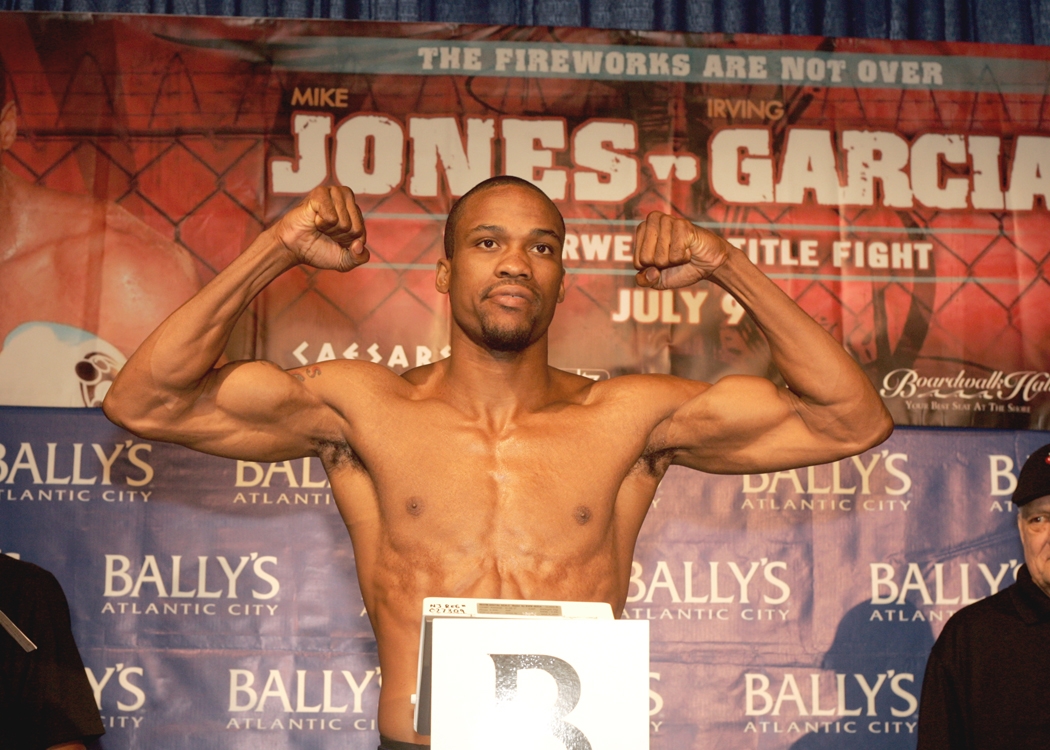
Mike Jones is in the right role and in step for move from apprenticeship to the HBO stage


It is the indispensable medium. Bob Arum and Oscar De La Hoya need television as much as Bill O’Reilly needs to shout into the cameras. But it is also a dilemma for young fighters impatient to get onto that rich stage as quickly as possible. Mike Jones is about to step through those ropes and into that light, which can be as unforgiving as it is bright.

That Jones has yet to do so can be viewed through a prism that casts a varied spectrum of interpretation. Prospects with less experience, a lesser record and a lot less potential have already been there. Fair or not, Jones has been waiting his turn, which finally comes on Nov. 13 beneath a screen that enriches as much as it exposes at Dallas Cowboys Stadium.

The wait, however, represents another opportunity, one which has been swept aside in the headlong rush to cash in before dues have to be paid. Jones, a Philadelphia welterweight who faces Jesus Soto-Karass on the HBO telecast of Manny Pacquiao-versus-Antonio Margarito, has served an apprenticeship. That’s a quaint notion, I know. Maybe, it’s even been forgotten. But forgotten fundamentals are a sure way to foreclosure.

While listening to Jones, promoter J Russell Peltz, Arum and Top Rank matchmaker Bruce Trampler on a conference call Wednesday, I couldn’t help but think that Jones hasn’t been allowed to forget lessons presented, reviewed and repeated at the rhythm and rate of a speed bag over the course of his 22-fight resume (22-0, 18 KOs).

A negative turned into a positive, Peltz said of Jones’ classroom away from HDTV’s defining portrayal.

“You can’t be beholden to the television networks,’’ Arum said. “If you are, you’re doing a disservice to your fighter.’’

More than a disservice.

It is irresponsible to both fighter and fan to push a prospect in front of the HBO cameras before he has a chance to discover whether he really wants to enter the crosshairs in pursuit of a living. Too many have. I still recall a former heavyweight, Danell Nicholson, saying that he wanted to be famous. Nicholson never said he wanted to be a fighter. Fame was his only objective. But it’s not a commodity. You can’t pick up a couple of pounds of it at the corner store

It was as if Nicholson had calculated that boxing was the quickest way to claim his share. But dangerous punches can get in the way of fame, money and common sense. A willingness to take those punches, endure them and counter them is the priority. Fame or money is the windfall, but it is only there if the prospect discovers that he likes to fight — first, foremost and mostly for himself. The cameras are incidental, almost like that windfall.

Among other things, Jones has had a chance to discover that, yeah, that willingness is within him like a heartbeat. Throughout his apprenticeship, he supported two daughters, aged four and six, with a day job at Home Depot. It would have been easy, even understandable, if he had decided to punch-in, punch-out and forget about punches at the gym.

But he didn’t. In the gym and away from the cameras, Jones, who has been compared to Thomas Hearns, learned that the brutal trade was his trade. He’s still learning and re-applying some of the fundamentals, including a more effective jab. He calls himself “a work in progress.’’ But it doesn’t sound as if there any doubts or looming identity crisis about where that progress is headed.

HBO is just a natural step in the progression.

NOTES, QUOTES
· Pacquiao fans must be getting nervous. According to reports from the respective camps, Margarito’s has been single-minded and his work uninterrupted. Meanwhile, Pacquiao has suffered from the flu and a slight foot injury. It might not matter; Pacquiao might win as expected. In the long wake of hand-wrap controversy in a loss Shane Mosley in January, 2009, however, Margarito has much to prove, He is armed with motivation to redeem himself. That’s powerful. Meanwhile, Pacquiao has a new career as a Filipino Congressman and an opponent not named Floyd Mayweather, Jr.

· More Margarito motivation: Lance Pugmire of the Los Angeles Times reported Thursday that Margarito has a bet with clothing manufacturer Affliction. He will wear the company’s T-shirt during HBO’s 24/7 series and into the ring. If he loses, he’ll only have the shirt. If he upset Pacquiao, he’ll win a renewal of his endorsement deal. It’ll be worth five figures.

· Two more reasons to forget about the heavyweight division are on the schedule, first Friday and then Saturday. Antonio Tarver is old enough for a cinematic rematch against Sylvester Stallone. Yet, he will make his heavyweight debut on ShoBox against Nagy Aquilera in Miami, Okla. On Saturday, Shannon Briggs faces Vitali Klitschko in Hamburg, Germany. Tarver, an insightful commentator for Showtime, and Briggs are personable. They’re great talkers. If only they could have talked their way out of these fights.


In celebration of Oscar’s candor


Heretofore, sincerity has not been a hallmark of the Golden Boy brand. Both as a fighter and promoter, Oscar De La Hoya has often used borrowed words to transport his statements someplace other than where his thoughts would steer them. But that changed last week.

In an interview with Broadcasting & Cable, one that was deeper and more honest than anything boxing writers have come to expect from the man or his company, De La Hoya spoke of a desire to take over boxing. He implied all would be better if he were granted sole authority over the sport.

In his words, and despite the semi-retractions that followed, De La Hoya set the truth free. Lacking an adequate lexicon of meaningless expressions, he spoke without his betters’ nuance. Bless him for it.

De La Hoya’s candor brought clarity. Golden Boy Promotions will no longer be able to hide in the silly, one-for-all costume that aspiring monopolists tend to don. And other promoters will no longer be able to make unsatisfactory efforts, lose to Golden Boy Promotions, and then feign victimhood. They now know De La Hoya wants to eat their children – to borrow another fighter’s timely candor.

Oh, but they were taken aback. “Is this not America!” they thundered. Along with a goodish number of commentators, Golden Boy Promotions’ rivals reached for the flag and free market. It was that reaction – indeed reactionary – that made De La Hoya’s unguarded statements provocative.

While some were boning up on MBA-speak in their twenties, De La Hoya was imperiling, and being imperiled by, others. Today, he wishes to obfuscate better than he’s equipped to do. Undoubtedly, he thinks capitalism is just a cool system for making him rich – like most everyone who prays at the altar of the free market. Frankly, you could name the system “potatoes” and not budge their faith.

And then there’s the idea of competition. Does any businessman ever celebrate it until he’s certain of the outcome? Only the winner erects a monument to competition. That doesn’t make it untenable, of course, it just means you should be suspicious of anyone in business who claims to love the idea.

What may well be untenable, though, is capitalism itself. The very system promoters and writers summoned against De La Hoya’s plot last week is what facilitated De La Hoya’s plotting in the first place. Contrary to 30 years of literature on the subject, capitalism is a great destabilizing force that devours itself and eventually puts us all on the same side of the ledger.

So long as one does not openly speak about driving others out of business, though, so long as his only sin is offering customers a better product – with that rubbery definition of “better” stretching to fit any circumstance at all – he is merely a market participant, blameless for the fate of his competition. Everyone purchases his product because he competes and wins, and we’re all better for it. Look at the innovation!

Except that we are not all better for it. Imbalances beget imbalances until no one is left on the other side of a trade. That is why boxing, for all its unscrupulousness and poor execution, still manages to reward 10 percent of its participants with 90 percent of its revenues.

Then it plays the poor ones off against one another, saying that they, too, could be rich one day. Though of course they can’t be.

De La Hoya’s plans for Golden Boy Promotions are not too dissimilar from Todd DuBoef’s plans for Top Rank.

“We need to sign all the talent and get all the TV dates,” De La Hoya said last week. “Then you can have your own agenda and have a schedule for the fans and the sport.”

“In boxing, virtually all of the publicity is keyed to a specific fight and, on a few occasions, to a specific fighter,” DuBoef said in June, by way of explaining a major impediment to his “brand of boxing” concept.

The biggest difference between those two statements? Polish.

Both De La Hoya and DuBoef cite as a model Major League Baseball, an entity which – as Norm Frauenheim pointed out Friday – enjoys an antitrust exemption. How about those animal spirits!

So let’s consider for a moment this “commission” of De La Hoya’s and “brand” that entices DuBoef, while the two men gaze longingly at professional baseball’s model. MLB is, of course, a league. And that league has a union to protect the interests of its employees.

Now ask yourself, is there a boxing promoter in this life or the next who wants prizefighters to unionize?

Until someone can answer yes to that question, let us have no more talk from promoters about being in the business to help fighters. Promoters are in boxing to enrich themselves, and whatever benefits accrue to outside parties are at best ancillary and usually accidental.

The bad news out of last week’s candor from De La Hoya was that nothing is new in boxing. Golden Boy Promotions is not the transformational entity it said it was years ago. The good news, too, is that nothing is new in boxing. There is little chance of one promoter gaining power enough to deal our sport a deathblow.

Whither Oscar’s vision, then? In 2003, columnist George Will ridiculed our President’s rosy prediction by writing: “Iraq needs only four people to achieve post-Saddam success. Unfortunately they are George Washington, James Madison, Alexander Hamilton, and John Marshall.”

Well, Oscar needs only three people to achieve his stated goal. Unfortunately they are Bob Arum, Bruce Trampler, and Lee Samuels.

Bart Barry can be reached via Twitter.com/bartbarry


Trust in Oscar: He’s No Monopolist


Oscar De La Hoya is shortsighted, misguided or just naive, but – please – he isn’t an enemy of the free-market system in comments this week about wanting to sign all of the talented fighters and secure the best television dates.

De La Monopolist, he is not.

In telling Broadcast & Cable that boxing needs to be run more like baseball or the National Basketball Association, De La Hoya is being as American as the New York Yankees. Since when haven’t the major leagues been able to sidestep anti-trust laws? Baseball has an anti-trust exemption.

In 2007, economist Andrew Zimbalist, a professor at Smith College and author of books on the sports business, told The New York Times:

“Each league is a monopoly and exercises significant market power by, (among other things), extracting significant public subsidies for the construction of facilities.

“The players in each league share in the monopoly booty.”

Enough said.

Unfortunately, De La Hoya said a lot more, too much more in the Q-and-A format. First, the Golden Boy Promotions president said he did not want to take over boxing. Then, he said, “in a way, yes, we do want to take over.’’ He wasn’t finished. In the next sentence, he said, “Well, we don’t want to take control of boxing, but we want to do the right thing for the sport.’’

De La Hoya is more of a politician than Congressman Manny Pacquiao. More than annoying, the yes-no-maybe spin is a unifying call for promotional rivals, who are having a tea party of their own in an overreaction to De La Hoya’s comments.

Not to worry. Boxing is the Balkans. Allies are temporary and always an imminent enemy. If it sounds like anarchy, it is and has been. Leave it to somebody else to decide whether that’s good or bad for business.

This week, at least, Paulie Malignaggi will probably says it’s very, very good after Golden Boy signed him to a contract in the wake of his last fight, a loss to Amir Khan, that prompted even him to concede that retirement was a consideration. In an attempt to expand the Golden Boy brand from west-to-east, from Los Angeles-to-New York, De La Hoya needed a well-known New York name to sell a deal to promote at the new Brooklyn arena, the Barclays Center, starting in 2012. There are questions about whether Malignaggi can still fight, but absolutely no doubt about whether he can talk through 2012 and beyond.

Above all, Malignaggi’s signing exposed – all over again – the game’s defining characteristic. He wasted little time and no apologies in a rip of his former promoter, Lou DiBella, whom he said did not market him enough. It was as unfair as it was embarrassing. But it was boxing. It illustrates a business guided more by bitter rivalries that unity.

For three decades, it was Bob Arum-versus-Don King. Now, Arum and King talk like old friends and loom as business partners if an agreement for a Pacquiao fight with Floyd Mayweather Jr. can ever be reached.

For Arum, however, the rivalry – a little bit like oxygen – is still there.

In De La Hoya, Arum has another one, which makes some fights tough to make and makes all those worries about a monopoly just look foolish.

Carbajal’s legal fight continues
Hall of Famer Michael Carbajal, a retired junior-flyweight from Phoenix, appeared Thursday in court with companion Laura Hall for a hearing to retain an order of protection against his neighbors, Carbajal niece Josephine and Jose Espinal.

Carbajal alleges that he and Hall were assaulted by Espinal and a couple of unidentified assailants on the night of Sept. 6. Through an interpreter who translated his Spanish, Espinal called the allegation a lie. He said he was not there. No charges have been filed. A criminal investigation is underway.

At the hearing in downtown Phoenix, Hall wore a cast on her left arm. She said two fingers had been crushed in the alleged incident. A bruise from a black eye was still evident. Photos of her injury and cuts to Carbajal’s face and head were provided as evidence.

Josephine alleged that Michael Carbajal had been drinking. Police officers, who answered the 911 call, said that they smelled alcohol. The hearing was continued. It will resume on Oct. 20.

It is just the latest battle in Carbajal’s star-crossed life. Brother and former trainer Danny Carbajal, Josephine’s father, is still in prison for stealing an estimated $2 million from his brother, who earned about $8 million over 49 fights. Danny Carbajal is scheduled for release in October 2011. Danny Carbajal’s wife, Sally, was murdered in Feb. 25, 2005, three days before they were scheduled to be in divorce court. The murder has never been solved. More than five years after Sally after was found dead from a gunshot, the murder is still a cold case.

Josephine entered a guilty plea for her role in the theft from Michael, who is trying to recover what was stolen from him in civil court. She was sentenced to probation. In April, she and Espinal moved into Danny’s former residence next to Michael’s boyhood home. Michael Carbajal said they moved into the house in an attempt to provoke him.

“They’re trying to make me to do something that will put me in jail,’’ said Carbajal, who continues to battle a drinking problem. “That’s what they want. It’s about greed. That’s what it goes back to. That’s what this is all about.’’

Notes, quotes and a couple of counters
· Golden Boy is suing Top Rank for allegedly trying to hide money that De La Hoya’s company says it is owed from three Pacquiao fights. Pacquiao advisor Michael Koncz reacted to the lawsuit suit, telling AOL: “I guess since Golden Boy doesn’t have any boxers to promote that are of any high quality, they have to find a fight somewhere, so they have chosen to fight in the courts through frivolous litigation.” Say what? Pacquiao trainer Freddie Roach might disagree. Roach trains the Golden Boy promoted Amir Kahn.

· And the International Boxing Federation is threatening to strip Devon Alexander of its junior-welterweight title if he fights Timothy Bradley instead of South African Kaiser Mabuza, the No. 1 contender. Where is the trash can that Riddick Bowe made so in famous in 1992? That’s where Bowe deposited the World Boxing Council’s heavyweight belt. That’s where the IBF’s 140-bout belt belongs right now.

Energizer Personal Care challenges itself.(Marketplace 2008/Corporate Profiles)(Company overview)

Chain Drug Review June 30, 2008 WESTPORT, Conn. — Energizer Holdings Inc.’s Energizer Personal Care division offers a diversified range of consumer products in the wet shave, skin care, feminine care and infant care sectors.

“Our portfolio includes such well-established brand names as Schick and Wilkinson Sword men’s and women’s shaving systems and disposables; Playtex tampons, gloves and infant feeding products; Banana Boat and Hawaiian Tropic sun care products; and Wet Ones moist wipes,” explains a company spokesman. “All of our products are directly in line with offerings of the drug store channel.

“We value the relationships we have developed with our customers and are excited about the opportunity to bring all of our businesses together for mutual benefit.” The company’s diverse portfolio can address the needs of an expansive variety of customers. For example, Banana Boat, Hawaiian Tropic and Wet Ones are geared toward basically every consumer group, including families and outdoor enthusiasts.

The company supports its brands with television, radio and Internet vehicles as well as through various sponsorships. this web site facial hair styles

“Our infant care products–which include bottles, sippy cups, Diaper Genie and mealtime products–are geared toward young families,” notes the spokesman. “Our wet shave business offers both men’s and women’s products with a wide range of items that fulfill the needs of those just beginning to shave and those who have shaved for several years or decades.

“And our feminine care line is there to meet the sanitary needs of women of various ages.” The company sees an opportunity in providing innovative products for each category in which it competes, to meet the growing and changing needs of its expanding customer base.

“We continue to challenge ourselves to be efficient while ensuring that we are investing in appropriate products and capabilities that will allow us to continue to bang consumer-preferred products and solutions to the marketplace,” adds the spokesman.

Energizer brought out a number of new products earlier this year, including the Quattro Trimmer razor and Wet Ones Sensitive Skin wipes. Also recently introduced were the Schick Quattro titanium razor and the Schick Quattro titanium shaving system, which is equipped with an edging blade on the back of the main razor to allow for cleaner edges on all facial hair styles. A tool for addressing more difficult-to-reach places (such as under the nose) is also incorporated with the razor, which features an ergonomicaliy designed, lightweight handle.

Banana Boat has launched Avotriplex, a proprietary formula that protects against UVA and UVB rays across all segments of the line. Playtex infant care products have made improvements across its bottles, pacifiers and cups. And Gentle Glide tampons are now available in a slender applicator and with ultra-absorbency. here facial hair styles

“Energizer has expanded through acquisition and organic growth,” says the spokesman. “Our recent acquisition of Playtex is a good strategic fit with our Schick business, bringing us efficiencies and scale with total Energizer Personal Care sales of $1.2 billion.

“Energizer holds a No. 1 or No. 2 position in all of the core categories in which it competes and will continue to grow by focusing on our consumers, categories and [retail] customers.” Energizer Personal Care a division of Energizer Holdings Inc.

300 Nyala Farms Road Westport, Conn. 06880 Key contact: Tim Grosskopf, Vice President of Sales, North America Web site: energizer.com Phone: (203) 341-4000 Primary businesses: HEALTH CARE Feminine care, sun care and infant care products; hand and face wipes BEAUTY CARE Razors, shaving systems GENERAL MERCHANDISE/SERVICES Household gloves Marketplace booth #2849
De La Hoya sees “racism” in Arizona law


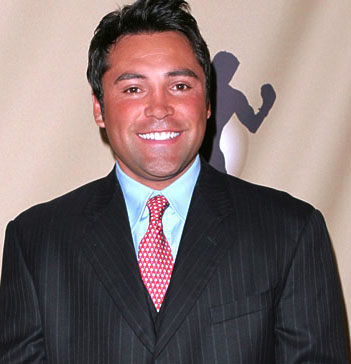
LAS VEGAS – Oscar De La Hoya said Wednesday that the Arizona immigration law is racist if it is allowed to stand as it was written.

“We’re looking at racism,’’ De La Hoya said during a news conference to promote the Juan Diaz-Juan Manuel Marquez rematch Saturday night at Mandalay Bay. “We really are.’’

De La Hoya made the comments while U.S. District Judge Susan Bolton filed an injunction in Phoenix against parts of SB 1070, delaying provisions that require immigrants to carry documentation and prohibits them from seeking employment on street corners or in parking lots. The law was scheduled to go into effect Thursday.

De La Hoya, president of Golden Boy Promotions and a fulltime promoter since he retired after a loss to Manny Pacquiao in 2008, said he would not stage cards in Arizona if the law is reinstated through likely legal fights, including an expected appeal by Arizona Gov. Jan Brewer.

Golden Boy promoted at Desert Diamond Casino near Tucson for a few years. The last Golden Boy card in southern Arizona was in the summer of 2009.

When asked if he could return to the state and promote again, De La Hoya said: “If they do lift the law, I would. But I don’t know now. If they don’t lift the law, then I don’t think we have business there.’’

Both Diaz and Marquez have fought in Arizona. Diaz, a Mexican-American lightweight, beat Fernando Angulo in 2006 at Chase Field in Phoenix. Marquez, a Mexican, has fought in Arizona twice, both in 2007 and both in Tucson. In his last Arizona bout, he beat Rocky Juarez, also of Houston, is also on Saturday night’s card at Mandalay Bay.

Six of the eight fighters on HBO’s pay-per-view portion have fought in Arizona, including middleweight Daniel Jacobs of New York junior-welterweight Robert Guerrero of Gilroy, Calif., and Joel Casamayor, an Olympic gold medalist from Cuba.

Diaz, an aspiring attorney, was born in Houston to parents, Olivia and Fidencio, who at the time were undocumented immigrants from Mexico.

“I talk about it with them and it hits home for them a little bit more,’’ said Diaz, whose parents took him back to Mexico briefly before returning to Houston. “They experienced it first-hand as far as crossing the border, dealing with border patrol and sometimes running from immigration. Those are some interesting stories.’’

The stories are also full of reasons to fear the SB 1070 if the courts allow it to be enforced, Diaz said.

“It’s a rough law,’’ he said. “It’s gonna infringe on a lot of human rights. Local law enforcement is going to take a little bit too much of the power that it has and abuse it. There’s going to be so many cases in which families and people are going to be abused that we’re not even going to hear about.’’

Despite his concern about the law’s potential abuse, Diaz said he would not rule out fighting in Arizona again.

“I’d have to look at the circumstances,” said Diaz, who Saturday hopes to avenge a loss to Marquez in the 2009 fight of the year. “I’m not going to sit here and say: ‘No, I’m never going to go fight.’

“You look at each, specific situation. If the situation is that they want to put on a show to raise money for immigrants, then it would be different. A lot of people automatically assume that they won’t fight there because of the law. But, like I said, I’d have to look at the circumstances. Then, say yes or no.’’

Marquez, who is from Mexico City, said the Arizona law has been talking point in his country ever since Brewer signed it in late April.

“It is bad, bad for me and bad for the Mexican people,’’ Marquez said. “Many Mexicans live in Arizona. I want to support them, help them through this.’’

De La Hoya said he understands those who argue that the United States has to defend its borders and maintain a process through which immigrants can gain legal entry.

“If you are illegal in this country and you’re a person who doesn’t come here to work and to help build America and to be in gangs and commit crimes and this-and-that, then, you-know-what, maybe you should go back,’’ said De La Hoya, who fought at then-America West Arena in Phoenix twice early in his career.”But if you are a person who is this country to help build America the way immigrants built America back in the day, then I think they do have a chance, that there should be fairness.

“I understand that there has to be a process, of how that is regulated.’’

De La Hoya says the law targets Mexicans and Americans of Mexican descent.

“They were thinking that this is meant for European immigrants, this is meant for the Asian immigrant,’’ said De La Hoya, who grew up in Los Angeles before becoming the world’s most popular and richest boxer after winning an Olympic gold medal for the U.S. at the 1992 Barcelona Games.

De La Hoya points to Arizona large Hispanic community, which is estimated to be about one-third of the state’s population.

“So, to a certain extent, I call it racism,’’ De La Hoya said. “I really do. What happens now? I got to Arizona. I look Hispanic. They pull me over and ask for my ID? It’s not fair.’’


“It’s 2-2, and that’s the way that it should be”


LOS ANGELES – In the hot blood that came immediately after his loss, blood that had streamed in his left eye and made a red mask of his face yet again, Israel Vazquez expressed a desire to fight Rafael Marquez a fifth time, to break their tie. Thirty minutes later, when everyone’s blood had cooled, Vazquez’s promoter Oscar De La Hoya shared a wiser sentiment.

“It’s 2-2,” De La Hoya said, “and that’s the way that it should be.”

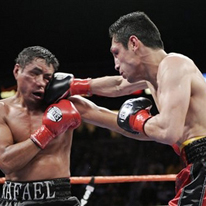
Saturday in Staples Center, Vazquez and Marquez made an unusual fourth fight that ended at 1:33 of round 3 when referee Raul Caiz Jr. astutely read Vazquez’s body language and precluded any further damage from being done to one Mexico City native by the other. Before Vazquez could drop to the canvas a second time, Caiz stepped in front of Marquez and waived the end. Marquez had evened the series. There was no reason to fight any more.

Finally, there was little reason for Vazquez and Marquez to have made their legendary trilogy into a disappointing tetralogy. If any energy coursed through Staples Center during the Friday weigh-in and Saturday undercard, it was an obligated sort. Those of us present showed dutifulness more than excitement. The larger venue and paychecks, too, were more honorary than celebratory:

We’d like to give you guys an apt send-off and pension, but to do it, unfortunately we’re going to need you to fight once more.

Vazquez and Marquez obliged – or should it now be Marquez before Vazquez? – and made an uneven end to their fantastically even beginning and middle. But if the fourth fight had to happen, its conclusion was unexpectedly merciful. For that we should be grateful.

Throughout, there was an appropriate theme of unity. Both men were Mexicans, world champions and gentlemen. This theme happened best during ring walks, when for the first time in memory, two fighters shared the same band, a Mexican mariachi group that paid homage to “La Patria.” The Staples Center crowd of 9,236 – a couple thousand more than attended Vazquez-Marquez III in nearby Carson, Calif. – was predominantly Mexican, too, if smaller than hoped.

If there was a moment that reminded you of the last time Vazquez and Marquez fought, it came in the opening seconds. The two men touched jabs more than gloves, and then Vazquez tossed a wild right hand Marquez’s way. It said, “We both know how you were at the end of our third fight, why don’t we pick things up right there?”

That was Vazquez’s most confident moment of the night and perhaps his last. Asked afterwards when he knew his opponent was in trouble, Rafael Marquez said he felt it on the end of his jab in round 1. As he once more sunk knuckles in Vazquez’s flesh, that is, Marquez noted something less resolved, a bit softer, somewhat less steeled. Fighters do sense that sort of thing; it’s a requisite tool in the box when your craft is hurting other men.

Ringsiders would not notice the slice Marquez put beneath Vazquez’s left eyebrow till it became gruesome in round 2. But it was there. Even from 30 feet away, a redness could be seen over Vazquez’s damaged eye in the first minute. And looking at pictures from early in Saturday’s fight, you now see darker blemishes in the tissue than the rosy hue that has dusted Vazquez’s eyebrows at his public appearances since 2008. Were it anyone else, you’d wonder if some handler had taught the man how to apply makeup en route to press conferences and award ceremonies, to ward away errant inquiries from careful journalists.

Marquez’s masterful right hand, among the finest seen in a generation, instantly knew better. It quickly took the flesh over Vazquez’s eye from nick to gash to wound.

“You could see the bone,” explained Vazquez’s veteran cut man Miguel Diaz afterwards. “You cannot stop these things with the medicine that we have.”

Then you stop the fight! Well, yes. Or maybe no.

Better that you do what Vazquez’s corner did. You tell your charge he gets one more round. You give him a last chance to measure himself, and you hope nothing gets permanently altered within him but his desire to fight on. And so, in the third round of his fourth fight with Rafael Marquez, Israel Vazquez relented.

He went down differently than he’d gone down in the fourth round of their third fight. He didn’t get knocked to the canvas by a concussive blow. He blindly wandered into a Marquez right cross, instead, and kneeled hopelessly. It was a distress signal from one of prizefighting’s noblest men. All read it. And had Caiz not closed things a few seconds later, Vazquez’s corner would have.

Had the fight been stopped by a ringside physician after round 2, the prospect of Vazquez-Marquez V would haunt both men, and their managers, and their fans. Were Vazquez able to attribute his loss to an accident of some kind, chances are good some of us would have to make another trek to California and see things to their bitter end. Who, after all, would deserve another chance if not Israel Vazquez?

No, it ended better this way. Vazquez was beaten, his incredible will subdued. Pushed for a retirement announcement at the post-fight press conference, he used the Spanish verb “meditar” – to meditate. He and his family will meditate on his future, think about it thoroughly, and see what it holds for them.

Those of us who came to this city to honor Vazquez and Marquez, to stiffen the ranks on press row or stand and cheer the men’s sacrifices as they walked to the ring, could never return for a fifth fight. All the reasons that brought us to this one would bar us from another.

Bart Barry can be reached at bbarry@15rounds.com